WhatsApp: +86 139 2872 8741
Email: [email protected]
Tel:
0086-757-8938 9313
0086-20-8938 9313
Address:
Caochang Industrial Area, Liguang Rd, Lishui, Nanhai, Foshan, Guangdong, China
Reply within 1 hour, 24x7 online service

WhatsApp: +86 139 2872 8741
Email: [email protected]
Tel:
0086-757-8938 9313
0086-20-8938 9313
Address:
Caochang Industrial Area, Liguang Rd, Lishui, Nanhai, Foshan, Guangdong, China
Reply within 1 hour, 24x7 online service
The problem in one line: a shop window has two lighting states, day and night, and most EL disappointments come from specifying for the wrong one.
We print and laminate EL posters in Foshan for window campaigns in leased shopfronts, malls and pop-ups. This brief covers the practical decisions: measuring the window, sizing to the glass, hiding the inverter, mounting without drilling, and judging daytime performance honestly. For the raw brightness numbers behind this page, the brightness explainer covers the 80-140 nits band and drive settings.
| Item | What we confirm in writing |
|---|---|
| Product | Printed, laminated EL poster on a PET base, 0.3-0.5 mm typical |
| Light output | 80-140 nits measured on our line, area glow with no hot spots |
| Weight | Under about 1 kg per square metre, typical |
| Daytime behaviour | Reads as a lit graphic; it does not overpower daylight |
| Best window condition | Evening, overcast, shaded glass or a covered arcade |
| Power options | Battery box, USB pack, 12V adapter on a timer, or AC 110-240V |
| Draw | About phone-charger scale for a typical poster, typical |
| Mounting | Reclosable tape, suction cups, clear standoffs or a slim frame |
| Lead time | Sample within 7 days of mockup approval; standard runs 7-10 days |
| Certificates | CE, FCC and RoHS available per project on request |
It is a printed light source, not a backlit picture. Seven thin layers stack into a panel you can roll, cut to shape and tape to glass. From the viewing side they run: printed graphic film with a laminate, clear PET base, transparent ITO electrode, silver bus bars, a phosphor layer doped with copper, a dielectric layer, and a rear electrode.
The panel glows across its whole face when an inverter pushes alternating current through it, typically 100-200V at 400-2,000 Hz. The inverter takes 3V, 5V, 12V or mains input. Nothing in the stack is hot: the surface stays near room temperature, which matters when a silk scarf hangs 40 mm away.
Two numbers describe it inside a window. Luminance, measured in nits, is how bright the face is: 80-140 nits on our line. Illuminance, measured in lux, is how much light falls on everything else in the window. A buyer who confuses the two will specify a poster that looks perfect at 21:00 and invisible at 13:00.
Thickness and weight are the quiet advantages. A 0.4 mm panel adds no box cavity, so the window keeps its full depth for product. At under about 1 kg per square metre it hangs from tape or suction cups, which means no drilling in a leased shopfront and no landlord conversation.
The window is the most expensive square metre in the store. Rent is priced on frontage, and the glass is the only surface that talks to people who never walk in. A poster that adds light after dark extends the selling day past closing time.
Depth is merchandise space. A light box 40-60 mm deep eats the window. A laminated panel takes less than a millimetre, so a mannequin can stand where the box used to be.
Campaigns rotate. Fashion, cosmetics and pharmacy windows refresh every 4-8 weeks. A thin panel ships flat or rolled, stores in a drawer, and returns next season without a crate.
Heat is a merchandising risk. Spot lamps aimed at a window can cook chocolate, cosmetics and printed cartons. EL runs cold, so it can sit close to product without a heat budget.
Leases forbid drilling. Most mall and high-street leases do. Tape, suction and standoffs solve the installation question before it reaches the landlord.
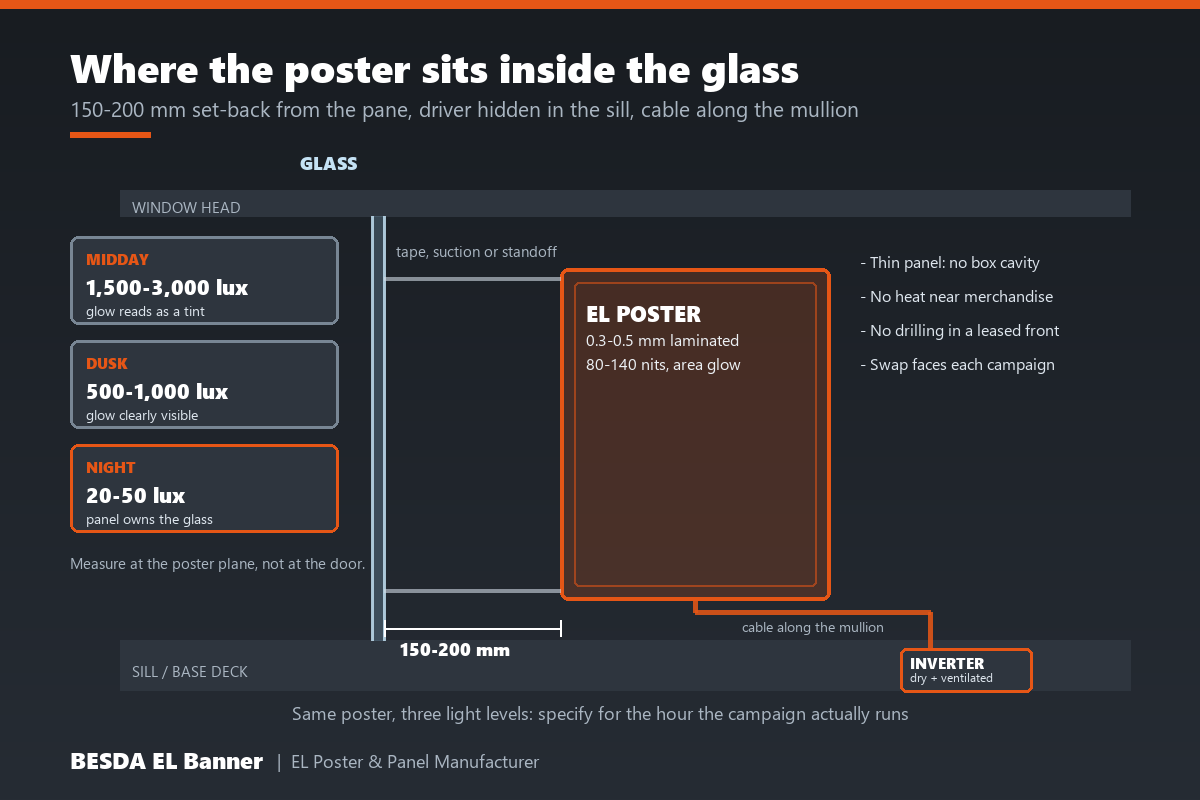
The glow competes with the room. Your eye judges the poster against whatever sits beside and behind it. A 120-nit face against a dark backing reads bright. The same face against a white wall lit to 2,000 lux reads as a pale tint. Position and surround decide more than the panel does.
Glass adds a second image. Clear float glass reflects roughly 4-8% of the scene in front of it. At eye level that reflection lands on top of your poster. Tilting the panel a few degrees, or moving it 150-200 mm back from the glass, pushes the reflection off the sightline.
Power has a path. The inverter is a small box, usually 60-90 mm long, that must stay dry and ventilated. In a window it hides in the sill return, behind the base deck, or in a shallow trunking along the mullion. Cables run vertically, never diagonally across the glass.
The glass traps heat. A south-facing window can run 10-15C above street temperature in summer. Heat accelerates phosphor fade, so shade the panel from the direct sun path and specify a UV-blocking laminate.
Mounting is mechanical, not adhesive guesswork. Reclosable fastener tape for flat glass, suction cups for a two-week campaign, clear standoffs for a permanent install, and a slim aluminium frame when the client wants a finished edge.
| Window type | Typical use | Why EL fits |
|---|---|---|
| Fashion and footwear | Evening hero graphic behind mannequins | Thin panel keeps window depth for product |
| Jewellery and watches | Small glowing brand mark on dark velvet | Cold light, no heat near display cases |
| Pharmacy and health | Late-hour offer panel facing the street | Readable after dark, low running cost |
| Convenience stores | 24-hour window strip for impulse lines | No warm-up, no glare into the till |
| Mall atriums and pop-ups | Portable glowing backdrop | Rolls into a tube between sites |
| Trade show booths | Backwall glow in a dim hall | Light, thin, ships as luggage |
| Automotive showrooms | Badge or model-name glow after hours | No heat near paint and trim |
| Beauty counters | Animated zone sequence on a dark field | Motion pulls the eye at dusk |
| Attribute | EL poster | LED light box | Printed graphic |
|---|---|---|---|
| Thickness | 0.3-0.5 mm typical | 25-60 mm typical | 0.1-0.3 mm film |
| Weight | Under about 1 kg/m2 | Several kg/m2 plus frame | Negligible |
| Daytime punch | Low: a lit graphic | High: 3,000-10,000 nits typical | Depends on window light |
| Evenness | Uniform area glow | Even on good units, banding on cheap ones | Not lit |
| Animation | 2-8 lit zones in sequence | Rare, needs extra hardware | None |
| Heat at the face | Near room temperature | Warm back panel | None |
| Power | Battery, USB, 12V or AC | Mains, higher draw | None |
| Install | Tape, suction, standoffs | Frame fixing and cable | Tape or clips |
| Shipping | Flat or rolled | Crated, bulky | Tube |
| Campaign swap | New panel or insert | New print inside frame | New print |
| Situation | Verdict | Why |
|---|---|---|
| Bar, restaurant or late-night window | WORTH IT | The glow owns the glass after dusk |
| Covered arcade, north-facing or shaded window | WORTH IT | Ambient stays under about 1,000 lux |
| Seasonal campaign reused 3-5 times | WORTH IT | A few hundred lit hours per season |
| Leased shopfront with no drilling allowed | WORTH IT | Tape and suction carry the panel |
| South-facing window in full summer sun | SKIP IT | Heat plus UV shortens life and washes the glow |
| Window with 3,000+ lux of accent light on the display | SKIP IT | A light box wins the contrast fight |
| Outdoor pavement sign facing rain | SKIP IT | Unsealed edges and weather do not mix |
| Video or fast motion is the brief | SKIP IT | EL sequences zones, it does not play video |
| Single graphic wider than about 3 m | CONSIDER | Possible, but shipping and budget favour tiling or a box |
1. Measure the glass and the sightline. Note width, height, sill height and the distance from the glass to the far pavement. A window read from 8 m needs different lettering than one read from 2 m.
2. Measure light at the poster plane, three times a day. Take readings at 10:00, 14:00 and 20:00. A phone lux app is enough for a first look; use a meter before a chain rollout. The 14:00 figure is the one that decides feasibility.
3. Size to the sightline, not the frame. Leave 150-200 mm of glass around the panel. Set headline cap height at about 5 mm per metre of viewing distance, and double it for comfortable reading from across the street.
4. Decide the power path before the artwork. A socket with a timer is the simplest. No socket means a battery box or USB pack in the sill. Tell us the lit hours per day and we set the drive preset accordingly.
5. Pick the mounting that matches the lease. Two-week campaign: suction cups. Season: reclosable tape. Permanent: standoffs or a slim frame. All three avoid drilling.
6. Design for the medium. Dark or mid-tone background, one saturated brand colour, strokes of 3-4 mm at final size, no thin serifs, no pastel gradients on white. A design that works on paper can disappear on a glowing face.
7. Follow the sample sequence. Artwork review, animation map where zones are used, mockup, physical sample, written approval, then production. Sample within 7 days of mockup approval, standard runs 7-10 days, larger bulk 15-20 days.
Judging from a phone photo. Cameras expose for the glow, so the room looks darker than it is and the poster looks brighter. Judge in the window, at the hour that matters.
Sizing to the frame instead of the sightline. A panel that fills the glass edge to edge leaves no breathing room and no room for the reflection to fall away.
White artwork on a white field. The glow has nowhere to contrast. Use a dark field or a strong colour block behind the message.
Sealing the inverter in a box. The panel runs cold; the driver does not. Trapped heat shortens driver life long before the phosphor fades.
Running the cable across the glass. It reads as a mistake to every passer-by. Route along the mullion or behind the base deck.
Specifying only for noon or only for midnight. Both states exist. A window brief that names one hour will fail at the other.
| Feature | Advantage | Benefit |
|---|---|---|
| 0.3-0.5 mm laminated panel | No box cavity behind the glass | Full window depth stays with the merchandise |
| 80-140 nits area glow | Even light with no hot spots | Product shots and logos read cleanly |
| 2-8 lit zones with a controller | Sequence steps in a programmed loop | Motion pulls the eye at dusk without a screen |
| Battery, USB, 12V and AC options | Power where no socket exists | Campaigns run in leased windows without an electrician |
| Under about 1 kg/m2 typical | Hangs on tape, suction or standoffs | No drilling and no landlord approval |
| Sample within 7 days | Test in the actual window before bulk | You decide with your own eyes, not a mockup |
1. Direct factory source better control quality. Printing, lamination, zone wiring and QC happen in our Foshan facility, so the build you approve is the build that ships.
2. 15+ years professional experience. We have produced electroluminescent displays for beverage, FMCG and retail clients since the early 2000s.
3. Smooth communication & fast response. One named contact handles your order, and we reply within 1 hour, 24×7, in writing.
4. Small qty acceptable. Most custom EL products start from 5 pcs, so you can test one window before committing to a chain.
5. Cooperated with more than 100+ global brands. Window campaigns across Europe, the Middle East and the Americas shaped how we quote this product.
6. Stable lead time & fast delivery. Sample within 7 days of mockup approval, standard runs 7-10 days, larger bulk 15-20 days, all confirmed in writing.
Yes, as a lit graphic rather than a dominant sign. In a daylit window the panel competes with 1,500-3,000 lux of accent light, so the glow reads as a soft tint. At dusk and after dark the same panel owns the glass. Test one in your own window before a rollout.
A 600 x 900 mm or 800 x 1,200 mm panel is the usual fit, leaving 150-200 mm of glass visible around it. Size the headline by sightline: about 5 mm of cap height per metre of viewing distance, and double that where people read from across the street.
Four options: a battery box, a USB power pack, a 12V adapter on a timer, or a direct AC 110-240V build. We confirm the pack size and expected lit hours in writing for your panel area and drive setting.
Yes. Reclosable fastener tape, suction cups and clear standoffs all hold a panel that weighs under about 1 kg per square metre. Clean the glass first, keep the panel out of the direct sun path, and route the cable along the mullion.
Heat and UV are the real enemies, not visible light. A laminated build with a UV-blocking face and a shaded position lasts its seasons. We quote lifespan as half-brightness hours, with voltage, frequency and temperature stated.
The panel is printed for one design, so a new campaign means a new panel or a printed insert behind a frame. Most retail buyers plan 3-5 campaign faces per window and keep the inverter and mounting hardware across all of them.
An EL poster is the thinnest way to put light in a shop window. It wins after dusk, in shaded windows and in leased shopfronts where nobody may drill. It loses to a light box in a sunlit window with 3,000 lux of accent light. Measure the window at 14:00, size to the sightline, hide the inverter, and test a sample in the real glass. Send the window measurements and the lit hours through our contact page and we will reply within the hour with a build, a drive preset and lead times in writing.
Send the size, quantity and destination country. We reply within 1 hour with feasibility, MOQ and lead time in writing.
Reply within 1 hour, 24×7 online service · [email protected]
Tell us the product, size, quantity and destination country. Attach artwork if you have it.
