WhatsApp: +86 139 2872 8741
Email: [email protected]
Tel:
0086-757-8938 9313
0086-20-8938 9313
Address:
Caochang Industrial Area, Liguang Rd, Lishui, Nanhai, Foshan, Guangdong, China
Reply within 1 hour, 24x7 online service

WhatsApp: +86 139 2872 8741
Email: [email protected]
Tel:
0086-757-8938 9313
0086-20-8938 9313
Address:
Caochang Industrial Area, Liguang Rd, Lishui, Nanhai, Foshan, Guangdong, China
Reply within 1 hour, 24x7 online service
The decision in one line: a bare EL panel is a light source, while an EL light box is a sign you can specify, install and service.
We build both in Foshan, so this page is not an argument for the more expensive option. It is the set of conditions where the frame earns its cost, and the conditions where it does not. If you are still choosing the light itself, the brightness explainer covers the 80-140 nits band and the drive settings behind it.
| Item | What we confirm in writing |
|---|---|
| Product | An EL panel fixed behind a face inside a rigid aluminium or acrylic frame |
| Frame depth | 20-40 mm typical, depending on the profile |
| Face | 2-3 mm acrylic or diffused PET; clear face plus a separate diffuser also works |
| Panel | 0.3-0.5 mm laminated EL sheet, 80-140 nits on our line |
| Dead edge | 5-8 mm unlit border at the silver bus bars, normally hidden by the frame lip |
| Light colour | Aqua-white, blue, green, yellow, orange or pink phosphor palette |
| Power | 12V adapter standard, AC 110-240V plug-in option, 3V or 5V packs for small sizes |
| Draw | About 0.5-2 W per 100 cm2 typical, cold surface at the face |
| Mounting | Wall screws, standoffs, hanging kit or a counter stand |
| Lead time | Sample within 7 days of mockup approval; standard runs 7-10 days; bulk 15-20 days |
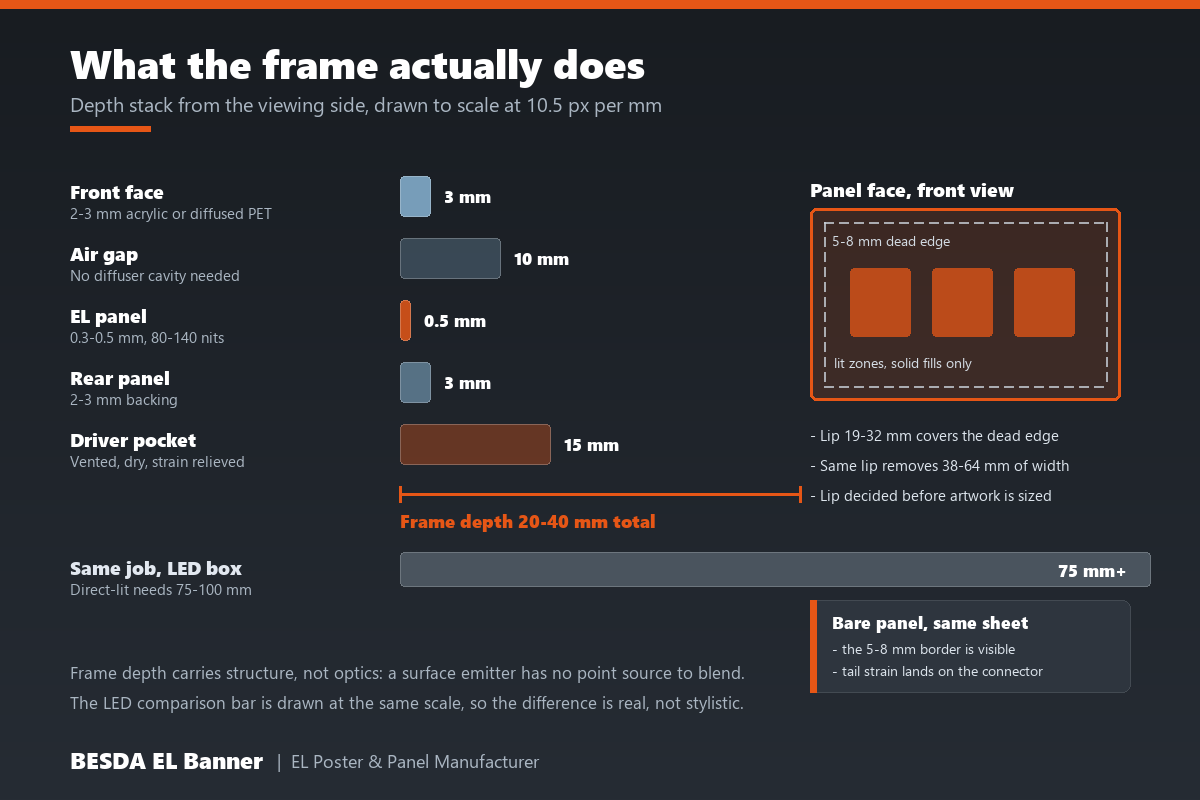
It is a laminated electroluminescent panel bonded behind a transparent face, inside a frame that holds both. Four parts do the work: the extrusion, the face, the panel and the driver pocket. Nothing else is required, because the panel already emits evenly across its whole surface.
That last point separates it from an LED box. An LED box starts with point sources and has to hide them. A slim edge-lit unit uses a light guide and stays near 25 mm. A direct-lit box with a large face needs 75-100 mm of cavity so the diffuser can blend the dots. An EL panel skips that problem entirely. Its depth carries structure, not optics.
So the 20-40 mm frame is doing mechanical work. The face protects the print from fingers and cleaning cloths. The lip covers the 5-8 mm unlit border where the bus bars run. The rear pocket holds the inverter away from the panel, so a pulled cable does not tear the light layer.
One physical limit belongs here at the start. An EL panel glows from one face. The rear is a printed electrode, not a light source. A double-sided sign therefore needs two panels back to back, and that doubles the light cost before any frame work begins.
The dead edge stops being visible. Every EL panel carries a 5-8 mm border where the silver bus bars sit and no light is emitted. On a bare sheet taped to a wall, that border reads as an unfinished edge. A 19-32 mm cover strip hides it and gives the sign a drawn line.
The connector stops being the weak point. In service, the tail is the part that fails. A cable snagged by a cleaner or a falling driver pulls on a joint that cannot be repaired. A frame lets us tie the tail and mount the driver on the housing, so the strain lands on the frame.
The print gets a cleanable surface. A bare laminated panel collects fingerprints at the tail and marks at the edge. A 2-3 mm acrylic face wipes down with a damp cloth, which matters in food service, clinics and any site with a cleaning rota.
Repeat campaigns get cheaper. The frame, face and driver stay. Only the panel changes. Buyers who run four campaign faces a year end up paying for light layers, not for housings.
A framed sign reads as a sign. This is not a technical point, but it decides budgets. A glowing sheet taped inside a window looks like a test. The same panel in a 25 mm silver extrusion looks like a fixture that belongs to the store.
Installation stops needing an electrician. A 12V build runs from an adapter on a timer. Two screws or a standoff kit finish the job. That removes a trade from the schedule and a permit conversation from the project.
The profile sets the depth budget. A 20-25 mm extrusion holds the panel and the face with a few millimetres to spare. Step up to 32-40 mm when the inverter and a cable channel must live inside the housing. Both are slim enough for a corridor or a reception wall.
The cover strip trades lit area for tolerance. A 19 mm lip hides the least and shows the most glow. A 32 mm lip hides more edge tolerance and more of the dead border, but it also removes 64 mm from the visible width. On a 600 x 900 mm panel that is a visible change, so decide the lip before the artwork is sized.
The face decides the character of the light. A 3 mm clear acrylic face keeps the print crisp and needs a separate diffuser sheet behind it. A 2-3 mm diffused PET face does both jobs in one layer and softens the image slightly. Neither changes the panel output; they change how much of it you see and how evenly.
The driver is the warm part. The panel stays near room temperature, but the inverter does not. It needs dry air and a little space. Sealing it into a closed pocket is the most common way to shorten the life of an otherwise healthy sign.
Access has to be decided early. A front-opening snap frame is the right choice when store staff will swap faces. A fixed extrusion with a rear service panel suits a permanent install where a technician attends. The two are not interchangeable after the extrusion is cut.
| Setting | Typical build | Why the frame matters |
|---|---|---|
| Retail counter and point of sale | Small framed face at eye level | Read at 1-2 m, so even light beats raw output |
| Hotel, bar and restaurant interior | Menu case, brand mark, wall panel | Warm ambience with no heat near finishes |
| Showroom product signage | Model name or badge beside product | Cold face, safe next to paint and trim |
| Airport and transit advertising | Backlit-style poster in a dim concourse | Thin housing fits shallow recesses |
| Cinema and venue foyer | Programme board or sponsor panel | Even glow without a bright screen |
| Pharmacy and clinic window | Late-hour offer panel | Readable after dark, low running cost |
| Trade show backwall | Brand wall in a dim hall | Ships flat, mounts in minutes |
| Museum and gallery label | Illuminated caption beside a dark exhibit | No spill, no heat, no visible hotspot |
| Attribute | EL light box | Bare EL panel | LED light box |
|---|---|---|---|
| Depth | 20-40 mm | 0.3-0.5 mm | About 25 mm edge-lit; 75-100 mm direct-lit on large faces |
| Face protection | 2-3 mm acrylic or PET | None, laminate only | 3 mm acrylic typical |
| Brightness | 80-140 nits | 80-140 nits | Roughly 1,000-10,000 nits on high-brightness units |
| Evenness | Even, dead edge hidden | Even, dead edge visible | Even when the diffuser gap is right |
| Heat at the face | Near room temperature | Near room temperature | Warm back panel |
| Power | 12V or AC, 0.5-2 W per 100 cm2 | Same panel draw | Higher draw, mains |
| Animation | 2-8 lit zones in sequence | 2-8 lit zones in sequence | Dimming and programming, not zone glow |
| Campaign swap | New panel, keep frame and driver | New panel, remount everything | New print inside the frame |
| Install | Two screws or a standoff kit | Tape, suction or clips | Frame fixing plus cable |
| Daylight | Poor above about 2,000 lux | Poor above about 2,000 lux | Built for daylight |
| Situation | Verdict | Why |
|---|---|---|
| Premium interior sign read from 1-3 m after dark | WORTH IT | The frame finishes the edge and hides the dead border |
| Counter or shelf piece handled by staff | WORTH IT | Face takes cleaning and knocks |
| Campaign that changes 3-5 times a year | WORTH IT | Panel swaps keep the housing |
| Site that needs a cleanable, sealed-looking unit | CONSIDER | Sealed build with gasket on request; documents confirmed per project |
| Wall where nobody may drill | CONSIDER | Standoffs and hanging kits solve most walls, confirm the substrate |
| Single face wider than about 1.5 m | CONSIDER | Shipping and frame cost rise; tiling or an LED box may suit better |
| Outdoor sign in direct sun | SKIP IT | The glow reads as a tint above roughly 2,000 lux |
| Display needing 1,000 nits or more | SKIP IT | EL output sits in the 80-140 nits band |
| Double-sided pavement or hanging sign | SKIP IT | Two panels back to back double the light cost |
| Video or fast frame-by-frame motion | SKIP IT | EL sequences zones, it does not play video |
| One-off test of under 5 units on flat glass | SKIP IT | A bare panel taped in place does the same job |
We turn down framed builds more often than buyers expect. If the sign faces direct sun, has to read from 30 m, or must hang double sided on a tight budget, a housing fixes none of that. The panel sets the ceiling, and a frame only decides how the panel is held and protected. Tell us the site conditions before the drawing, and we will say which side of that line the project sits on.
1. Name the job of the sign. Attention after dark, a finished brand surface, or a readable board. Each answer moves the budget to a different part: light, frame or face.
2. Measure the wall and the viewing distance. Note the available width, the mounting height and the closest and furthest viewer. Set cap height at about 5 mm per metre of viewing distance, and double it for reading from across a room.
3. Choose the lip before the artwork. A 19 mm lip shows more glow. A 25-32 mm lip hides more edge tolerance. Fix this number early, because it changes the visible lit area.
4. Choose the face as one decision, not two. Clear acrylic plus a diffuser sheet gives the crisper image. A single diffused PET layer gives the simpler assembly. Both are 2-3 mm.
5. Set the depth from the driver, not from the panel. If the inverter lives inside, allow 32-40 mm. If it lives in a ceiling void or a cabinet, 20-25 mm is enough.
6. Decide who opens the box. Store staff: front-opening snap frame. Service technician: fixed extrusion with rear access. This choice cannot be reversed later.
7. Confirm the power path in writing. Adapter on a timer, AC plug-in, or a battery pack for small sizes. State the lit hours per day, because drive settings follow the duty cycle.
8. Follow the sample sequence. Artwork review, mockup, physical sample within 7 days of mockup approval, written sign-off, then production. Standard runs take 7-10 days and bulk 15-20 days.
Cutting the frame before the artwork is final. The lip covers part of the panel. If the design was laid out for the full sheet, the headline loses its top line. Size the artwork to the visible opening, not to the panel.
Putting copy in the dead edge. Text inside the 5-8 mm bus bar border will never glow, and part of it will sit under the lip. Keep a safe margin inside the lit area.
Sealing the inverter. A closed pocket traps heat around the one part that does not run cold. Vent it, and keep it away from the panel tail.
Expecting daylight performance. A framed box does not add brightness. If the site has 3,000 lux of ambient light on the sign, the answer is a different technology, not a deeper frame.
Forgetting the double-sided case. A hanging sign needs two panels, two tails and usually two drivers. Quoting it as one build produces a surprise at production.
Choosing a clear face with no diffuser. On a printed panel with a visible texture, a clear face can show the print pattern as a slight grain. Add the diffuser sheet or use a diffused face.
| Feature | Advantage | Benefit |
|---|---|---|
| 20-40 mm aluminium profile | No optical cavity is needed for a surface emitter | A shallow wall or recess takes a finished sign |
| 19-32 mm cover strip | Hides the 5-8 mm bus bar dead edge | The sign looks drawn, not cut from a sheet |
| 2-3 mm acrylic or PET face | Protects the print and wipes clean | Staff can clean it without damaging the light layer |
| Frame-mounted driver with a tied tail | Strain lands on the housing, not the connector | The most common field failure is designed out |
| Front-opening snap frame option | Panel swaps without tools or a technician | Campaign faces change in minutes |
| 80-140 nits with no hot spots | Even light across the whole face | Logos and product shots read cleanly edge to edge |
| 12V adapter, AC plug-in or battery | Power where the socket is not | Install without an electrician or a permit |
1. Direct factory source better control quality. Printing, lamination, zone wiring, framing and QC happen in our Foshan facility, so the build you approve is the build that ships.
2. 15+ years professional experience. We have produced electroluminescent displays for beverage, FMCG and retail clients since the early 2000s.
3. Smooth communication & fast response. One named contact handles your order, and we reply within 1 hour, 24×7, in writing.
4. Small qty acceptable. Most custom EL products start from 5 pcs, so you can fit one site before committing to a rollout.
5. Cooperated with more than 100+ global brands. Interior, retail and event programmes across Europe, the Middle East and the Americas shaped how we quote this product.
6. Stable lead time & fast delivery. Sample within 7 days of mockup approval, standard runs 7-10 days, larger bulk 15-20 days, all confirmed in writing.
No. The light comes from the same panel, so the output is the same 80-140 nits we measure on our line. A clear 3 mm face passes most of it. A diffused face turns a little of it into evenness and loses some peak output. We confirm the face and the measured value together.
20-40 mm typical, depending on the profile. A 20-25 mm profile holds the panel and the face only. A 32-40 mm profile also carries the inverter and a cable channel inside the housing. An EL panel is a surface emitter, so it does not need the deep cavity that a direct-lit LED box uses.
Yes, if the panel outline, thickness and connector position match the profile. Send a drawing with the panel size, the connector side and the tail length. We confirm fit in writing before the frame is cut.
A sealed build with a gasket is possible on request, but daylight is the harder limit. The glow reads as a pale tint above roughly 2,000 lux of ambient light. Use it on a shaded facade or accept that it works at night and not at noon.
You keep the frame, the face and the driver, and swap the panel. That is why the profile matters: a front-opening snap frame lets a store team change the face in minutes, while a fixed extrusion needs rear access and a technician.
Not with one panel. An EL panel emits from one face only, so a double-sided unit needs two panels back to back, two tails and usually two drivers. That roughly doubles the light cost, and we quote it as a separate build.
Buy the frame when the panel has to survive handling, hide its dead edge and change faces more than once. Skip the frame when the job is a short test on flat glass, a sunlit position, or a double-sided sign where two panels double the light cost. Send the wall size, the viewing distance and the lit hours through our contact page and we will reply within the hour with a profile, a face option and lead times in writing.
Send the size, quantity and destination country. We reply within 1 hour with feasibility, MOQ and lead time in writing.
Reply within 1 hour, 24×7 online service · [email protected]
Tell us the product, size, quantity and destination country. Attach artwork if you have it.
