WhatsApp: +86 139 2872 8741
Email: [email protected]
Tel:
0086-757-8938 9313
0086-20-8938 9313
Address:
Caochang Industrial Area, Liguang Rd, Lishui, Nanhai, Foshan, Guangdong, China
Reply within 1 hour, 24x7 online service

WhatsApp: +86 139 2872 8741
Email: [email protected]
Tel:
0086-757-8938 9313
0086-20-8938 9313
Address:
Caochang Industrial Area, Liguang Rd, Lishui, Nanhai, Foshan, Guangdong, China
Reply within 1 hour, 24x7 online service
The problem in one line: a cooler door holds the best advertising spot in the aisle, but a printed sticker goes dark the moment the aisle light drops. An EL fridge sticker keeps that spot lit without heat, without noise and without a power cable across the floor.
We manufacture electroluminescent posters and stickers in Foshan, and beverage buyers ask three things before the first order: will it survive a cold, damp door, how does it power, and how does it animate. This guide answers all three with production facts. If you are still sizing the graphic, the EL poster size chart for fridges, shelves and windows is the companion read. For shaped outlines that follow a bottle or a logo, see custom shape EL posters.
| Item | Typical value |
|---|---|
| What it is | A printed graphic laminated onto a 0.3-0.5 mm electroluminescent panel with a small driver |
| Typical size | A4-A3 on single cooler doors; A2 strips on multi-door units |
| Brightness | 80-140 nits; our fresh panels start at about 140 nits |
| Panel thickness | 0.25-0.55 mm, so it sits flush on the door face |
| Curvature | Follows gentle curves; industry-typical minimum bend radius 5-10 mm; never crease |
| Light modes | Constant, breathing, flashing; sound-activated on request |
| Animation | 2-8 lit zones in a fixed sequence |
| Power input | Battery box, USB, or AC adapter; draw is phone-charger scale |
| Unlit border | 5-8 mm dead edge from the bus bars on all four sides |
| Lead time | Sample within 7 days of mockup approval; runs 7-10 days; bulk 15-20 days |
An EL fridge sticker is a sandwich about half a millimetre thick. The front film carries the printed brand art, and a laminate protects it from condensation and cleaning. Behind the print sit the light layers: a clear PET base, transparent electrodes, the phosphor layer and a rear electrode. The whole stack glows as one flat sheet.
The panel glows, the print decides what you read. The phosphor layer emits a uniform field of light, and the ink on top blocks or passes it. Dark type on a lit field reads the way dark type reads on paper, which is why brand marks stay sharp even while the panel is on.
The sticker is one sealed unit. Graphic and light layer are laminated together, so a campaign update means a fresh print. Repeat runs start from 5 pcs, which keeps a seasonal refresh a small order rather than a project.
Two fixing options cover most doors. Adhesive backing is the default and holds the sticker flat for the life of the campaign. Magnetic construction costs a little more but lets a merchandiser lift the sticker off and swap it for the next promotion without tools or residue. Both keep the face flush against the door panel.
The driver is the only bulky part. A small inverter turns 5 V or 12 V DC into the AC field the panel needs. It hides behind the door panel, inside the cooler plinth or above the cabinet, and a short lead exits at the bottom or side edge, which is decided before production.
The door is the last touchpoint before the grab. A shopper stands in front of it for seconds. A lit brand face at that moment does more than a poster ten metres back, because the message and the product sit in the same line of sight.
The campaign leaves the shelf. Branding on the door face extends the promotion from inside the cabinet to the outside, so one cooler advertises to everyone who walks past, not only to the shopper who opens it. That is the whole reason cooler-door media exists.
Aisles are dimmer than buyers expect. Retail aisles often run a few hundred lux, and bar back-areas less. An 80-140 nit glow sits well above a dark door panel, so the brand face reads clearly, while staying far below the glare level that annoys staff working the aisle.
The surface stays cold. EL is a capacitive cold-light layer with near-zero heat output, so it is safe against refrigeration equipment, painted steel and vinyl wraps. Nothing warps, nothing warms the door, and nothing adds load to the cabinet.
Animation earns the second look. A breathing border or a flashing claim line moves without a video screen. Two to four zones is the sweet spot on a door card; more zones on a small face read as noise. In bar and club settings, a sound-activated sticker can pulse with the room.
Power is chosen per venue. A battery box suits doors where no socket is reachable, and the box hides behind the panel or inside the plinth. USB suits counters and window displays where a power bank or USB outlet is nearby. An adapter suits fixed installs next to mains. The sticker plus driver draws about what a phone charger draws, so the venue rarely notices.
Modes are set on the driver. Constant light suits brand marks that must read steadily. Breathing and flashing suit promotions that should pull the eye. Some driver boards add a small button or remote to switch modes on site; availability is confirmed per project before the sample is built.
Moisture is the real design constraint. A cooler door sweats when warm humid air meets a cold surface. The panel itself is not waterproof, so we laminate the face and seal the edges, and the construction is chosen for wipe-down cleaning. Where a door environment is extreme, the ingress protection target is agreed in writing and tested on the sample.
Cleaning stays simple. A damp cloth with mild detergent is the routine. No solvents on the edges, no pressure jets, no scraping with blades. Treated that way, a sticker carries a campaign for its full season and often into the next one.
| Equipment | Typical sticker | Notes |
|---|---|---|
| Single-door upright cooler | A4-A3 door card | Headline brand zone at eye level; battery or adapter power |
| Double-door aisle cooler | A2 strip or two A3 cards | Reads across the aisle; adapter power keeps it always on |
| Bottle cooler in bars | A4 logo card or collar strip | Dim room flatters the glow; sound-activated mode optional |
| Open chiller | Shelf-edge strip | Narrow lit strips mark the brand block without blocking product |
| Chest freezer lid | A3 card, magnetic | Flat lid face suits it, but customer abrasion is real; treat as CONSIDER |
| Cafe or bakery display fridge | A4 card | Low ambient light behind the counter; USB power is enough |
| Attribute | EL fridge sticker | Printed vinyl | Magnetic sign |
|---|---|---|---|
| Glow | Lit face, 80-140 nits | None; needs aisle light | None; needs aisle light |
| Animation | 2-8 zones, breathing or flashing | None | None |
| Surface fit | Flush; follows gentle curves | Flush on flat areas | Flush; lifts off cleanly |
| Reuse | Reprint per campaign from 5 pcs | Single campaign | Reusable across campaigns |
| Heat on the door | Near zero | None | None |
| Best job | Brand face that must read in dim aisles | Long-run flat graphics | Seasonal swaps on bare steel |
| Situation | Verdict | Why |
|---|---|---|
| Dim aisle or bar back-area brand face | WORTH IT | The core case: glow at the last touchpoint, zero heat |
| Seasonal cooler takeover across stores | WORTH IT | One zone map, many doors; reprint from 5 pcs per market |
| New flavour launch with a breathing accent | WORTH IT | 2-4 zones animate one claim without a screen |
| Humid tropical market, sealed door build | WORTH IT | Lamination and edge seal chosen for wipe-down service |
| Chest lid handled by staff all day | CONSIDER | Abrasion and lifting by hand; decide after a sample |
| Bright window wall in daylight | SKIP IT | Aisle-level glow loses to the sun; use printed or LED there |
| Food-contact surfaces | SKIP IT | The sticker is a door face, never a food-contact item |
An honest boundary sits behind that table. EL is a close-range, low-ambient medium. On a sunlit storefront or a billboard distance, an 80-140 nit panel will not carry the message, and we will say so in the first email. Daylight behaviour is covered plainly in this guide on daylight visibility. In those spots, printed vinyl or an LED sign is the right tool, and a good factory should tell you so before the sample, not after it.
1. Confirm the door model and the flat area. Send the cooler model, a door photo with a tape measure in frame, or the door template if the chain has one. The flat area inside the frame decides the sticker size, and the corner radius decides how far the lit area can reach.
2. Send vector artwork and the zone map. Printers want AI or PDF layered files. Mark which zones light, in which order, and which parts stay dark. The zone map is the single most useful file in the whole job; it turns a brand idea into a buildable panel.
3. Choose adhesive or magnetic. Adhesive for a fixed campaign, magnetic for seasonal swaps. Say which, because it changes the backing stack and the edge seal.
4. Choose the power route. Battery box, USB, or adapter, and where the cable exits. Bottom exit suits plinths; side exit suits door frames. A cable across a walkway is a safety problem, not a design choice.
5. Approve a mockup, then a lit sample. The mockup settles layout and zone order on screen. The lit sample follows within 7 days of mockup approval, and it is checked on a real door face, at real aisle distance, before sign-off.
6. Run mass production with photo QC. Standard runs take 7-10 days and bulk programmes 15-20 days. Each panel is lit-checked, and photo records go to the buyer with the shipment papers. Energy-drink coolers in the United States, pub back-bars in the United Kingdom, bakery counters in Germany and hotel minibar programmes in the UAE all run this same five-step path.
7. Pack for export and install in minutes. Panels ship flat with corner protection, and the driver travels in the same box. On site, the sticker presses on in minutes, the cable tucks away, and the door face lights on the first test.
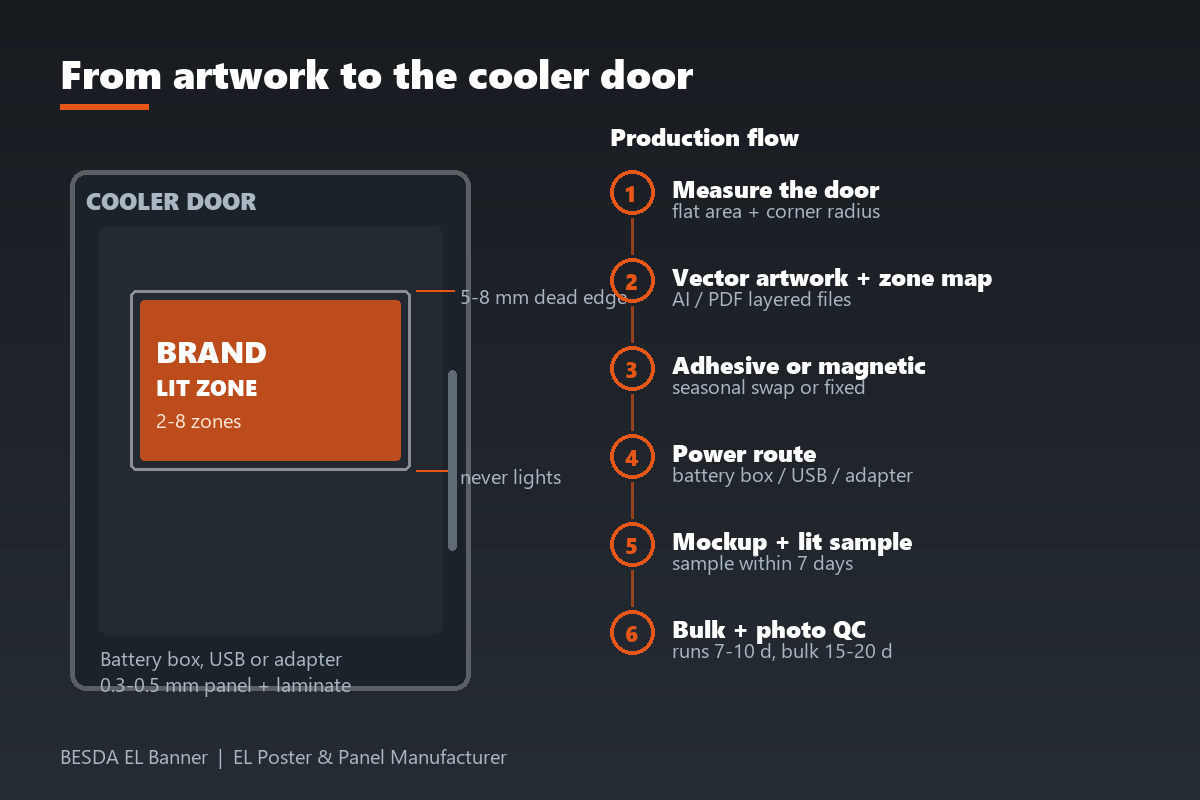
Artwork to the very edge. The bus bars create a 5-8 mm border that never lights. A logo parked there goes dark and half-hidden. Keep the brand mark inside the lit field and let the border be border.
Assuming any door is flat. Most cooler doors are flat glass or steel panels, but corner radii and recessed handles vary by cabinet. One taped photo of the real door prevents a sticker that bridges a curve and delaminates at the edge.
A visible battery box or a cable across the aisle. The driver needs a hiding place, and the cable needs a route. Decide both before production. A zip-tied box dangling beside a cooler reads as an afterthought to every shopper who passes.
Skipping the moisture conversation. Humid climates condense on cold doors. Face lamination and edge sealing are the answer, and they must be in the build spec, not an upgrade request after two stickers peel.
Too many zones on a small face. Eight zones on an A4 card turn the animation into flicker. Two to four zones with a clear order read as motion. The mockup is where this gets fixed, so treat it as a lighting decision, not a formality.
Gloss laminate under aisle spotlights. A high-gloss face mirrors the overhead lighting and fights the glow. A matte or soft-touch laminate keeps the lit field the brightest thing on the door.
| Feature | Advantage | Benefit |
|---|---|---|
| 0.3-0.5 mm panel | Sits flush on the door face, follows gentle curves | No raised fixture to catch trolleys or cleaning cloths |
| 80-140 nits even glow | Brand face reads in dim aisles without glare | The door advertises whenever the aisle light drops |
| 2-8 animation zones | Breathing or flashing accent on one claim | Launches get noticed without a screen or a budget for one |
| Battery, USB or adapter input | Fits doors with and without sockets | One product family covers a whole fleet |
| Cold-light surface | Safe against refrigeration panels and vinyl wraps | Installs where lamps are not allowed |
| Reprint from 5 pcs | Seasonal refresh stays a small order | One venue can test before a chain rollout |
1. Direct factory source better control quality. Printing, lamination, sealing and the lit-check happen in our Foshan facility, so the sticker on your cooler is checked by the people who built it.
2. 15+ years professional experience. We have made electroluminescent displays for beverage and retail programmes since the early 2000s, and cold-door durability is a solved problem on our floor.
3. Smooth communication & fast response. One named contact answers from artwork to shipment, and we reply within 1 hour, 24×7, in writing.
4. Small qty acceptable. Custom runs start from 5 pcs, so one test market can prove the concept before a multi-store rollout.
5. Cooperated with more than 100+ global brands. Beverage and retail campaigns across Europe, the Middle East and the Americas shaped the production rules on this page.
6. Stable lead time & fast delivery. Sample within 7 days of mockup approval, standard runs 7-10 days, bulk 15-20 days, confirmed in writing on every order.
The panel itself is not waterproof, so the build matters. We laminate the printed face and seal the edges, which is the standard approach for cold, humid doors. Wipe-down cleaning is fine with a damp cloth. A formal IP rating for a specific door environment is confirmed per project and stated in writing.
Three routes are common: a battery box behind the door panel, a USB power bank, or an AC adapter to a nearby socket. The panel and driver draw about the same as a phone charger, so the load on the venue is small. Exact runtime on cells depends on sticker size and animation load, and we confirm it in writing per project.
Measure the flat area inside the door frame, then subtract the lit border. Most single-door coolers take an A4 to A3 card, and multi-door units take A2 strips. The silver bus bars create a 5-8 mm unlit border, so keep logos and claims inside that line.
Yes. Two to eight lit zones can run a fixed sequence, and constant, breathing and flashing modes are standard; a sound-activated option follows music in bar settings. Aqua-white is the brightest phosphor, while brand colours come from filter inks that run dimmer, so we balance the zone map on the mockup.
Low MOQ accepted, with wholesale custom runs starting from 5 pcs. That lets a single venue or one test market try a design before a chain rolls it out. Mixed designs in one small batch are also workable, subject to a quick feasibility check.
Mockup review comes first, and the lit sample follows within 7 days of mockup approval. Standard runs complete in 7-10 days, and bulk programmes run 15-20 days. Each order is confirmed in writing before production starts.
A cooler door does not need a screen. It needs a lit brand face that survives a cold, damp surface, powers from a battery box or a USB lead, and animates one claim at a time. An EL fridge sticker does that in a 0.3-0.5 mm sheet that presses on in minutes and draws phone-charger power. Send the door model, artwork and target market through our contact page, and we will return a size and power recommendation with a sample plan within the hour.
Send the size, quantity and destination country. We reply within 1 hour with feasibility, MOQ and lead time in writing.
Reply within 1 hour, 24×7 online service · [email protected]
Tell us the product, size, quantity and destination country. Attach artwork if you have it.
