WhatsApp: +86 139 2872 8741
Email: [email protected]
Tel:
0086-757-8938 9313
0086-20-8938 9313
Address:
Caochang Industrial Area, Liguang Rd, Lishui, Nanhai, Foshan, Guangdong, China
Reply within 1 hour, 24x7 online service

WhatsApp: +86 139 2872 8741
Email: [email protected]
Tel:
0086-757-8938 9313
0086-20-8938 9313
Address:
Caochang Industrial Area, Liguang Rd, Lishui, Nanhai, Foshan, Guangdong, China
Reply within 1 hour, 24x7 online service
The problem in one line: most buyers can describe what an EL poster does but not what is inside it, so they cannot judge quotes, brightness claims or lifespan promises when suppliers differ.
We print EL panels in Foshan, and this page is the plain-English version of what we explain to engineering buyers: seven printed layers, one small inverter, and a zone map that makes a flat poster move. No physics degree needed.
| Item | The short answer |
|---|---|
| What it is | A flexible printed sheet that glows across its whole surface under AC power |
| Layers | Seven: substrate, transparent electrode, bus bars, phosphor, dielectric, back electrode, artwork film with lamination |
| Thickness | About 0.2-0.5 mm after lamination |
| Drive | An inverter steps 3V/5V/12V DC (or mains) up to roughly 100-200 V AC |
| Frequency | 400-2000 Hz typical; more frequency gives more light and faster ageing |
| Brightness | 80-140 nits band; white builds measure highest |
| Lifespan | Rated to half-brightness; starts near 140 nits and drifts gradually toward 80 nits |
| Animation | 2-8 lit zones sequenced by a controller; sound-activated option |
| Heat | Cold-light process; the surface stays safe to touch |
| Certificates | CE, FCC and RoHS available; details in writing on request |
An EL poster is a large flat capacitor that emits light. Two electrodes sandwich a phosphor layer; alternating current across them makes the phosphor glow evenly, edge to edge. There is no bulb, no tube, no backlight strip and no pixel grid. The whole surface is the lamp.
It is not an LED product. LEDs are points of light that need diffusers to look even; EL is even by nature. It is not a screen either: it shows one lit graphic with zones switching in sequence, not moving images. And it is not paper – it needs power and an inverter, which is where most of the engineering lives.
The consequence for buyers: if you need thin, even, animated glow on a surface, EL fits. If you need daylight punch or video, other technologies win, and our light box line exists for exactly that case.
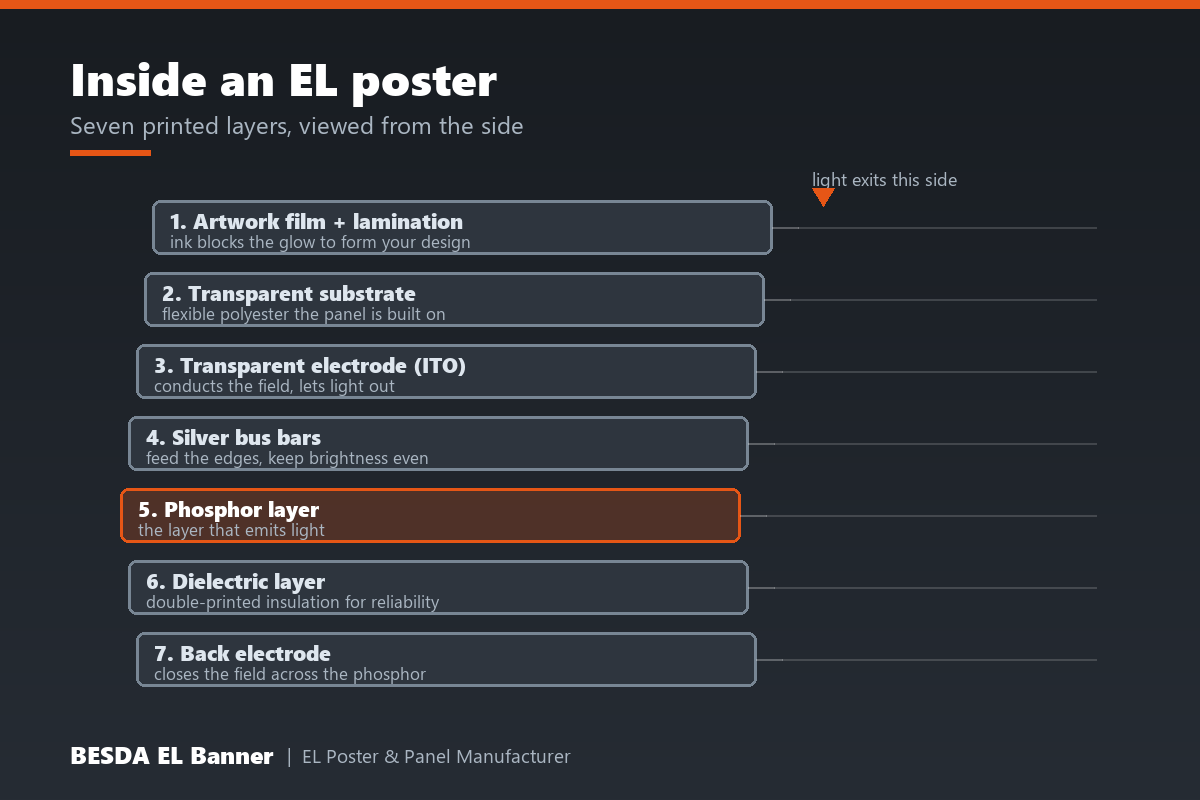
A printed EL panel is built like a sandwich, one screen-printed layer at a time. From the side you look at, the stack runs:
| Layer | What it does | Notes from the line |
|---|---|---|
| Layer | What it does | Notes from the line |
| Artwork film + lamination | Carries your design; ink blocks the glow to form the graphic | Swapped between campaigns; lamination seals moisture |
| Transparent substrate | The flexible polyester base the panel is built on | Light exits through this side |
| Transparent electrode (ITO) | Conducts the field while letting light through | A whisper-thin coating on the substrate |
| Silver bus bars | Feed current to the electrode edges | Keep brightness even; create the 5-8 mm dead edge |
| Phosphor layer | The layer that emits light when the AC field crosses it | Zinc sulfide doped for color; the heart of the panel |
| Dielectric layer | Insulates the sandwich; usually double-printed | Sets reliability; too thin invites shorts |
| Back electrode | Closes the field across the phosphor | Printed silver and carbon, opaque |
Two practical rules fall out of this stack. First, the electrode edge is real: keep 5-8 mm of your design clear of the cut edge, or hide the zone under a printed border. Second, the panel flexes but does not fold – gentle curves mount fine, a sharp crease cracks the electrodes and kills a line of glow permanently.
Inside the phosphor, energy turns into light through a three-beat cycle that repeats with every swing of the alternating current:
1. The field flips. The inverter reverses the voltage across the sandwich hundreds to thousands of times per second. Each reversal rebuilds the electric field through the phosphor.
2. Electrons sprint. When the field crosses the threshold, electrons trapped at the layer boundaries jump into the phosphor and accelerate through it, picking up energy from the field.
3. Light escapes. The energised electrons strike luminescent centres in the phosphor and knock them into an excited state. As each centre settles back down, it gives the energy back as a photon – a pulse of light.
Because the current is alternating, every cycle fires two pulses, and the pulses blend into the steady even glow your eye sees. Nothing filament-thin runs white-hot, which is why the panel stays near room temperature and why the glow has no hot spot in the middle. It is also why EL sips power: the panel is capacitive, so almost no steady current flows – a full-size poster and its inverter typically draw about what a phone charger does.
The inverter is the small box between your power source and the panel. Its job is to turn friendly low-voltage DC – 3V, 5V or 12V from a battery, USB or adapter, or mains from the wall – into the roughly 100-200 V AC at 400-2000 Hz that the phosphor needs. It is also where every trade-off you care about is decided:
| Inverter setting | Raise it and… | The cost |
|---|---|---|
| Inverter setting | Raise it and… | The cost |
| Output voltage | Brightness rises | Ageing speeds up; parts stress earlier |
| Output frequency | More light pulses per second, so more brightness | Half-brightness arrives sooner; hue shifts bluer |
| Waveform quality | Clean sine drive runs efficiently | Square-wave harmonics shorten panel life |
| Power sizing | A driver matched to the panel area runs cool | Undersized drivers dim and die early |
Run the numbers hard and the panel is brilliant but short-lived; run them gently and it lasts but looks tame. Our panels ship with a driver matched to the rated settings: new panels measure around 140 nits, and under rated drive the output drifts gradually – roughly 130, 120 and down toward 80 nits past the 8,000-hour mark – rather than dropping off a cliff. Panels keep working below that; they are just gentler. If a poster looks dim years earlier than expected, the dim-after-a-year checklist covers the usual culprits, most of which are drive or moisture, not age.
One honest note: some inverters emit a faint hum at drive frequency. If your installation is a quiet hotel lobby rather than a bar, say so at quote time – silent-running builds exist, and the fix is trivial before production and impossible after.
The raw phosphor glows aqua-white, and that base is the brightest build you can order. Color is layered on top: printed filter inks over the phosphor produce green, blue, orange and the rest. Every filter eats a little light, which is why a deep blue panel measures visibly dimmer than white at the same drive – the physics, not the factory, sets that limit.
Frequency also tints the output: drive higher and the glow shifts slightly bluer and brighter; drive lower and it warms toward green. That is why two EL panels of the same color can look subtly different side by side, and why we drive matched panels from one shared inverter plan in multi-panel installs.
A flat sheet moves because it is printed as several separate lit areas – zones – each fed by its own connection. A sequence controller switches the zones on and off in a pattern, and your eye reads the pattern as motion:
2-4 zones blink a price, alternate two messages, or sweep left to right. This is the workhorse range for shelf and counter pieces.
5-8 zones can tell a small story: a glass filling up, a countdown, a route tracing across a map. Zones need area and viewing distance to read cleanly, so this range belongs on A2 panels and larger.
Sound-activated builds replace the fixed pattern with a trigger: the controller listens for bass and flashes zones with the beat. Bars and stage backdrops love it; libraries do not.
The file that makes this work is the animation map: your artwork split into layers, one per zone, each numbered to match the controller. Approving that map is the single most important checkpoint in an animated order – after zones are printed, changing them means a new panel. The full flow from map to finished panel sits in our guide to first custom EL poster orders.
| EL poster | LED light box | LCD screen | |
|---|---|---|---|
| EL poster | LED light box | LCD screen | |
| How it makes light | Whole surface glows from phosphor | LED strips behind a diffuser | Backlit pixels |
| Thickness | About 0.2-0.5 mm, sticks flat | Frame 25-60 mm deep | Screen plus housing and player |
| Motion | 2-8 sequenced zones | Static print | Full video |
| Power draw | Very low; capacitive load | Moderate; mains typical | Highest of the three |
| Dim room impact | Excellent even glow | Good | Good |
| Direct daylight | Poor – the honest limit | Good | Good |
| Runs on batteries | Yes, for small panels | No | No |
| Best role | Thin, shaped, animated glow at the point of sale | Large even light for walls | Changing content and video |
| Worth it when | Skip it when |
|---|---|
| Worth it when | Skip it when |
| The space is dim and the glow carries the message | The display faces hours of direct sun |
| The panel must stay thin and light on doors or glass | A framed light box already fits the recess |
| You want motion without a screen or media player | You need video or content that changes daily |
| Battery or low-draw power matters | The panel is metre-scale and always near mains |
| The shape is custom: outlines, bottles, logos | A plain printed poster says the same thing today |
Read the right column twice before ordering. We turn down daylight builds regularly, and the honest limit protects both of us: a panel that disappoints in week one is a refund conversation, not a reorder.
1. Run it at the rated drive. Swapping in a hotter inverter for a short-lived brightness kick trades years of life for weeks of wow.
2. Keep it flat in storage. Store panels flat or loosely rolled per the packing spec; a crease is a dead line that no repair brings back.
3. Keep moisture out. The lamination is the seal. If an edge gets nicked, reseal it before humidity finds the electrodes.
4. Unplug between campaigns. Lifespan counts lit hours. A panel that glows four hours a night lasts roughly six times longer on the calendar than one running around the clock.
5. Clean the surface, not the edges. A damp cloth on the lamination is fine; solvents and edge-soaking sprays are not.
1. Direct factory source, better quality control. Panels are printed, laminated and wired in our Foshan facility. No trading layer between you and the line, so a spec change reaches the operator the same day instead of a week later.
2. 15+ years professional & expert experience. We have been producing electroluminescent displays since the early 2000s for beverage, FMCG and event clients. That history is why we can tell you in the first call whether your idea will print cleanly.
3. Smooth communication & fast response. One named contact handles your order from quote to shipping. We reply within 1 hour, 24×7, and we answer in writing so nothing depends on a phone call you cannot forward to your team.
4. Small qty acceptable. Most custom EL products start from 5 pcs. You can test a market, a single store or one event before committing to a production run.
5. Cooperated with more than 100+ global brands. Work from beverage, cosmetics, telecom and retail clients across Europe, the Middle East and the Americas has taught us the artwork and compliance quirks of each market.
6. Stable lead time & fast delivery. Production slots are booked when your deposit lands, and the sampling and bulk dates are confirmed in writing. If a deadline is unrealistic we say so before you pay, not after.
No. The panel is a capacitive load, so a full-size poster and its inverter typically draw about what a phone charger does, and small panels run for days on a battery box. That is the main reason battery-powered displays are practical at all.
Drive settings set brightness: higher voltage and frequency give more light but faster ageing. Panels shipped from us are matched to their rated inverter, so a poster that looks tame next to a hotter-driven one is usually running different drive, not a weaker panel.
Yes. Electroluminescence is a cold-light process – nothing runs hot inside the panel, so the surface stays near room temperature. The inverter case is the warmest part of the system and stays comfortable to handle.
Under a roof, at night, or on a shaded facade, yes, with sealed lamination for moisture. In direct daylight the glow washes out – that is the honest limit of the technology, and for sunlit walls we quote an LED build instead.
The panel is printed with separate lit zones, each with its own feed, and a sequence controller switches them in a pattern – commonly 2-8 steps. A sound-activated controller replaces the fixed pattern with beat triggers. The artwork ships with a numbered animation map so you know exactly what moves when.
Lifespan is rated to half-brightness under stated drive conditions. New panels measure around 140 nits and drift gradually toward about 80 nits beyond roughly 8,000 hours, then keep working at reduced brightness. Running at rated drive and switching off between campaigns stretches the calendar life.
An EL poster is a seven-layer printed capacitor: phosphor glows, the inverter sets how bright and how long, and a zone map makes it move. Judge any supplier – us included – on three things: stated brightness with drive conditions, lifespan expressed as half-brightness hours, and a written spec sheet. A factory that volunteers those numbers is a factory that can build the panel. If you want them for your project, message us on WhatsApp or email, and we reply within 1 hour, 24×7.
Send the size, quantity and destination country. We reply within 1 hour with feasibility, MOQ and lead time in writing.
Reply within 1 hour, 24×7 online service · [email protected]
Tell us the product, size, quantity and destination country. Attach artwork if you have it.
