WhatsApp: +86 139 2872 8741
Email: [email protected]
Tel:
0086-757-8938 9313
0086-20-8938 9313
Address:
Caochang Industrial Area, Liguang Rd, Lishui, Nanhai, Foshan, Guangdong, China
Reply within 1 hour, 24x7 online service

WhatsApp: +86 139 2872 8741
Email: [email protected]
Tel:
0086-757-8938 9313
0086-20-8938 9313
Address:
Caochang Industrial Area, Liguang Rd, Lishui, Nanhai, Foshan, Guangdong, China
Reply within 1 hour, 24x7 online service

The problem in one line: buyers know EL posters glow. They are far less sure where the glow actually wins attention – and where daylight quietly kills it.
We print EL posters and animated EL panels every week in our Foshan factory. This page maps them to real occasions: store openings, product promotions, trade shows, ice cream campaigns, auto show tents, sports events and golf days. It also covers how they work, what goes inside, how we produce them, and how to install one in under an hour. If you want the layer-by-layer technology, read how an EL poster actually works; this page is about choosing the right site and the right build.
| Item | What we confirm in writing |
|---|---|
| Product | EL poster: a printed sheet that glows. Animated panel: same sheet with 2-8 lit zones switching in sequence |
| Thickness | About 0.2-0.5 mm printed build with lamination; mounts flat on glass, walls and curved doors |
| Brightness | 80-140 nits band; new panels measure around 140 nits |
| Life | Around 8,000 hours before brightness eases from 140 toward 80 nits; a gradual fade, not a switch-off |
| Power | Battery box, USB, 12V or mains adapter; an inverter always sits between the source and the panel |
| Animation | 2-4 zones on panels up to about A3; 5-8 zones on A2 and larger; sound-activated option |
| Minimum order | Low MOQ accepted; most first runs start from 5+ pcs, mixed sizes allowed |
| Sampling | Mockup first; a physical sample ships within 7 days of mockup approval |
| Production | 7-10 days standard runs; 15-20 days for larger bulk orders |
| Certificates | CE, FCC and RoHS; certificate numbers and a written spec sheet on request |
An EL poster is short for an electroluminescent poster. It is a paper-thin printed sheet that lights up across its whole surface when an alternating field passes through the phosphor layer inside. The artwork is printed on top, so the design reads as a bright silhouette once the room dims. There is no frame, no bulb and no hot spot.
An animated EL panel is the same structure with one upgrade: the glowing area is split into separate zones. A small sequence controller lights the zones in order, so a bottle outline blinks, a price pulses, or a slogan sweeps across the panel. You get motion without a screen, a media player or a single moving part.
Both are printed products, not displays. They show one fixed graphic with light behind it. On our EL posters page you can see the size bands we build from, from A5 counter cards to spliced backwall sections.
Three parts do the job. The panel is a seven-layer printed stack; the phosphor layer between two electrodes emits light under an AC field. The inverter converts ordinary DC input – a battery box, a USB port or a 12V line – into the high-voltage AC the panel needs, typically 100-200V at 400-2000 Hz. The controller decides which zone lights and when.
The drive settings set the personality of the panel. Higher voltage and frequency mean more brightness and a shorter life; the industry works in a band where a new panel reads around 140 nits and still glows usefully near 80 nits thousands of hours later. Power options and driver sizing are laid out in our EL poster power guide.
EL earns its place where light is dim, the surface is thin or curved, and motion matters more than raw brightness. Those conditions repeat across seven occasions we ship for every month.
| Occasion | Why it works | Fit |
|---|---|---|
| Store opening nights | The event runs into the evening; an animated logo loops all night on a wall or the shopfront glass | Strong |
| Product and menu promotions | A zone switch highlights the new item or the price without reprinting the whole sheet | Strong |
| Ice cream and beverage freezers | A 0.2-0.5 mm panel plus a battery box sticks to curved freezer doors; no drilling, no wiring in the cabinet | Strong |
| Bars, clubs and restaurant walls | Dark rooms are the natural habitat; the glow reads across the room at 80-140 nits | Strong |
| Trade show booths | Panels pack flat in a carton, run on 12V, and survive show after show with the same graphic | Good |
| Auto shows with tented displays | Inside a shaded tent the glow carries evening reveals; pair the panel with the tent branding wall | Good, evening slots |
| Sports events and golf days | Registration desks, prize walls and night-hole sponsor signs; battery power reaches where cables cannot | Good, evening slots |
| Sunlit outdoor walls | Daylight overpowers the glow; we quote an LED build instead | Not recommended |
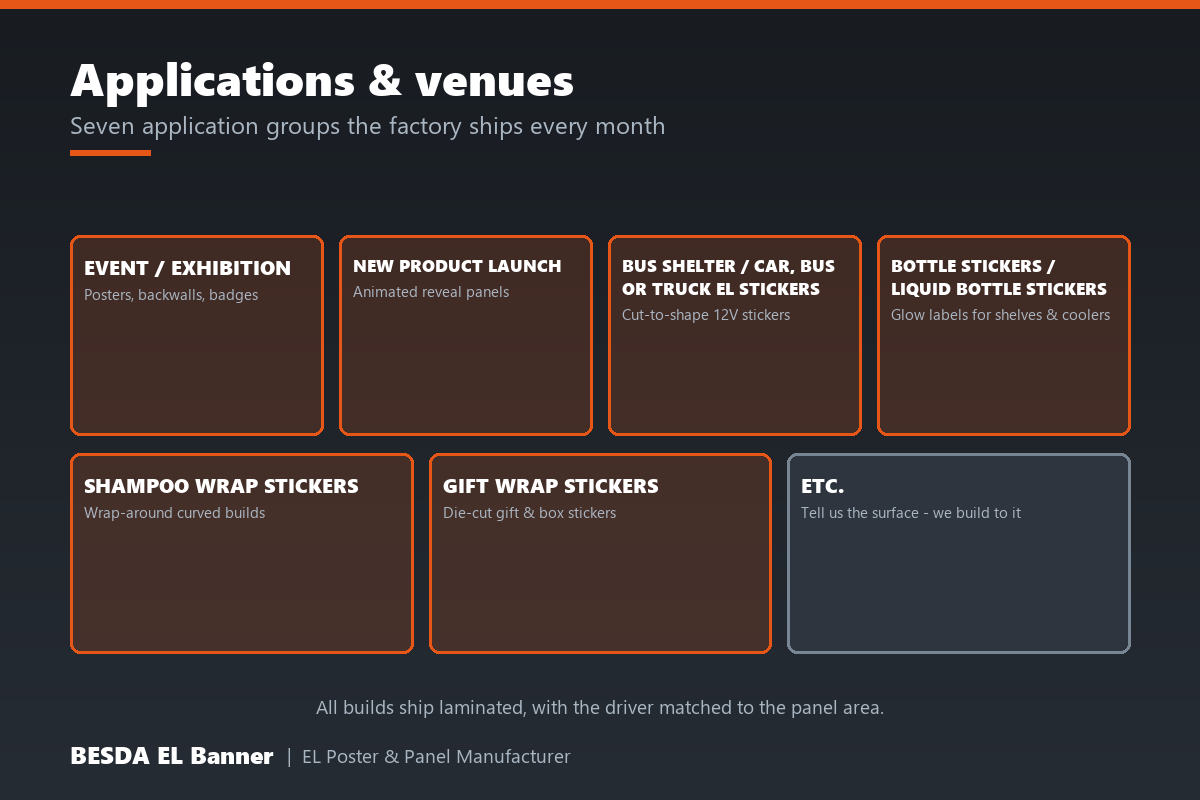
The pattern is consistent: the darker and thinner the site, the more EL stands out. One global ice cream brand ran freezer-door panels through a summer season; a golf sponsor reused the same prize-wall panels across three weekend events. Neither needed a socket within reach.
| Worth it when | Skip it when |
|---|---|
| The site is dim or runs into the evening: stores, bars, booths, freezer aisles | The wall takes direct sun for most of the day |
| The surface is thin or curved: glass, freezer doors, columns, tent walls | The site suits a deep frame or a large even light anyway |
| You want motion without a screen or a media player | You need video or content that changes daily |
| The campaign repeats across 3-5 events or seasons | It is a one-afternoon piece with no reuse planned |
| No socket is available and battery power matters | The panel would need an oversized battery bank to cover a huge area |
One honest limit covers most disappointments: EL is a dim-light medium. At 80-140 nits it holds its own against a lit shop interior in the evening, but direct sunlight washes the glow out completely. For sunlit facades we say so and quote an EL light box or LED build instead. Telling you this before the deposit is part of the job.
1. Settle power before artwork. Battery box, USB, 12V or mains decides the panel size, the cable run and who installs it. A freezer door takes a battery box; a backwall wants 12V from the booth supply.
2. Match zones to distance. Two zones blink a price that reads from 3 metres. Five to eight zones tell a sequence that rewards a viewer standing still. Every extra zone is a printed boundary, so keep the count honest.
3. Brief for glow, not for print. Bold shapes and thick strokes light up cleanly; hairlines and gradients vanish. Layered vector artwork with strokes at 2 mm or more survives both printing and glowing.
4. Plan the daylight hours. If the site runs all day, add printed graphics that carry the message until the EL takes over after dusk. The two layers cost little and close the gap.
5. Test on the real power, in the real light. A sample judged on an office desk proves nothing. We ship samples within 7 days of mockup approval precisely so you can test at the actual site.
The panel is a stack of printed functional layers on a flexible base. Knowing the stack explains most quotes, most failures and most of what a supplier can or cannot customise.
| Layer | Role |
|---|---|
| Artwork film + lamination | Carries your design; ink blocks the glow to form letters and shapes |
| Transparent PET substrate | The flexible base; the full build stays near 0.2-0.5 mm |
| ITO transparent electrode | Carries the field forward while letting light out |
| Silver bus bars | Feed the panel edges; they create a 5-8 mm unlit border we plan around |
| Phosphor layer (ZnS:Cu) | The layer that emits light under the AC field |
| Dielectric layer | Double-printed insulation that keeps the panel stable over hours |
| Back electrode (silver + carbon) | Closes the field across the whole surface |
| Sealed lead + connector | Exit position on request: bottom, side or hidden behind the panel |
Lamination is what stands between the panel and humid or outdoor air. A laminated panel tolerates evening dew and cleaning wipes; an open edge does not. Weather ratings are confirmed per project, in writing, before production starts.
Step 1. Artwork review. We check your file for printability: layered AI or PDF, strokes at 2 mm or more, text outlined. If a hairline will vanish when lit, we flag it before quoting.
Step 2. Animation map. For animated builds you approve a numbered zone map – zone 1, zone 2, zone 3 – with the sequence spelled out. Re-cutting zones later means remaking the panel, so this sign-off matters.
Step 3. Screen printing. The phosphor, dielectric and back electrode are screen printed in register onto the PET base. Registration across layers is what keeps the glow even.
Step 4. Die-cutting. The panel is cut to your outline – a bottle, a badge, a mascot. Tooling stays on file, which is why reorders skip the sampling stage.
Step 5. Lamination and edge sealing. The graphic film is laminated on top and edges are sealed. This step decides how the panel survives humidity and handling.
Step 6. Aging and QC. Every panel is lit and checked before packing; QC photos go to you first. The written spec sheet – brightness band, drive settings, thickness, connector – travels with the order.
Step 7. Export packing. Flat cartons with desiccant, packed for the destination port. Our sampling process page shows how the mockup-sample-approval loop fits before these steps.
1. Plan power and driver position first (5 minutes). Find the socket or battery spot, then measure the cable run. The driver sits in a ventilated spot you can still reach for battery swaps.
2. Clean the surface (5 minutes). Glass and painted walls need a degreased wipe; dust under tape is the number one cause of falling panels.
3. Fix the panel (10-20 minutes). Double-sided tape or Velcro for glass and freezer doors; an aluminium frame or PVC backing plate for walls. Both keep the panel flat without screws through the lit area.
4. Route and hide the lead (10 minutes). Exit at the corner we marked on the mockup, run the cable through a channel, and leave slack so the connector never carries tension.
5. Match the driver to the panel (5 minutes). EL is a capacitive load. A driver sized for the panel area runs at spec; an under-sized one runs dim, and an inverter should never be switched on with no panel attached.
6. Test the sequence (10 minutes). Step through every zone, check the sound trigger if fitted, and set the on/off routine the staff will actually follow.
Total hands-on time for a standard A2 panel: under an hour with one person. Larger spliced builds add layout time, not new skills.
Buyers usually weigh EL against two LED options on the same site. The table below settles it on the factors that decide the occasion.
| EL poster / animated panel | LED light box | |
|---|---|---|
| Motion | 2-8 animated zones, no screen | Static print behind lit panel |
| Thickness | 0.2-0.5 mm, sticks flat | Frame 25-60 mm deep |
| Power draw | Low; small panels run on batteries | Higher; mains expected |
| Dim bar or freezer aisle | Excellent | Good |
| Direct daylight | Poor – honest limit | Good |
| Curved or irregular surface | Dies to shape, wraps gently | Rectangular frames only |
If the deciding factor is daylight or a very large even field, LED wins and we will say so. If it is thinness, shape or battery power, EL wins on all three at once.
| Feature | Advantage | Benefit |
|---|---|---|
| 0.2-0.5 mm printed stack, 7 layers | Mounts on glass and curved doors without a frame | Install in under an hour, no drilling |
| 2-8 animation zones per panel | Motion without a screen or media player | Viewers stop; the message plays on loop |
| 80-140 nits in a dim-light build | Tuned for evenings, aisles and booths | Visible all night at low power draw |
| Battery box, USB, 12V or mains input | Runs where no socket exists | Golf days and booths without cabling |
| CE, FCC and RoHS available | Paperwork ready for retail compliance | Customs and venue checks move faster |
1. Direct factory source better control quality. Panels are printed, laminated and wired in our Foshan facility. A spec change reaches the operator the same day, not after a trading round-trip.
2. 15+ years professional experience. We have produced electroluminescent displays since the early 2000s, which is why we can tell you in the first call whether your idea will print cleanly.
3. Smooth communication & fast response. One named contact handles your order from quote to shipping, and we reply within 1 hour, 24×7, in writing.
4. Small qty acceptable. Most custom EL products start from 5 pcs, so you can test one store, one event or one market before a production run.
5. Cooperated with more than 100+ global brands. Beverage, cosmetics, telecom and retail clients across Europe, the Middle East and the Americas taught us the artwork and compliance habits of each market.
6. Stable lead time & fast delivery. Production slots are booked when your deposit lands, and sampling and bulk dates are confirmed in writing before you pay.
Yes in evening and shaded slots: registration desks, prize walls, night holes and tented zones all work. In direct sunlight the glow washes out, so sunlit sites get an LED recommendation instead. Weather sealing is laminated per project and confirmed in writing before production.
The lit area is split into 2-8 zones and a sequence controller lights them in order – a bottle blinks, a price pulses, a slogan sweeps. You approve a numbered animation map before sampling. Sound-activated versions follow music beats.
Battery box, USB, 12V or mains – chosen by panel size and cable run. The driver is matched to the panel area, and the sample is tested on the real power at the real site before bulk production.
Low MOQ accepted. Most first runs start from 5+ pcs, and mixed sizes are allowed within one run on the same material. Feasibility and dates are confirmed in writing.
A physical sample ships within 7 days of mockup approval. Standard production runs 7-10 days; larger bulk orders run 15-20 days. Every date is confirmed in writing before you pay.
CE, FCC and RoHS are available, with certificate numbers and a written spec sheet per project on request. Ask before shipping so the paperwork travels with the goods.
EL posters and animated panels win where the light is dim, the surface is thin, and motion needs no screen. They lose in direct sun, and the suppliers worth quoting will say that out loud. Match the occasion to the fit table above, settle power before artwork, and approve a mockup before production. Then send the surface size, quantity and destination country through our contact page – you will have feasibility, MOQ and lead time in writing within the hour.
Send the size, quantity and destination country. We reply within 1 hour with feasibility, MOQ and lead time in writing.
Reply within 1 hour, 24×7 online service · [email protected]
Tell us the product, size, quantity and destination country. Attach artwork if you have it.
