WhatsApp: +86 139 2872 8741
Email: [email protected]
Tel:
0086-757-8938 9313
0086-20-8938 9313
Address:
Caochang Industrial Area, Liguang Rd, Lishui, Nanhai, Foshan, Guangdong, China
Reply within 1 hour, 24x7 online service

WhatsApp: +86 139 2872 8741
Email: [email protected]
Tel:
0086-757-8938 9313
0086-20-8938 9313
Address:
Caochang Industrial Area, Liguang Rd, Lishui, Nanhai, Foshan, Guangdong, China
Reply within 1 hour, 24x7 online service
The problem in one line: thickness is the specification nobody asks about until the poster curls off a curved cooler door, or a fold line goes dark two weeks after installation.
We print and laminate EL posters in Foshan, and most builds run 0.3-0.5 mm before lamination. That number decides how the piece mounts, how it packs and how far it can bend. This page sets out the real limits: what thickness measures, where the bend radius comes from, what breaks first, and when a flexible build is the wrong answer. For the neighbouring question of what you are buying, the panel versus poster comparison is the shorter read.
| Item | Working value |
|---|---|
| Printed EL stack | 0.3-0.5 mm before artwork film and lamination |
| Finished poster | Slightly thicker – lamination adds a film layer, total confirmed per project |
| Bend radius | About 5-10 mm on a gentle curve; flatter is safer |
| Repeated flexing | Not supported – EL is flexible, not flexing |
| What fails first | The transparent ITO electrode, which cracks before the plastic layers do |
| Bend direction | Bend the whole sheet across its width, never a fold at one point |
| Storage | Flat in the original carton; large pieces rolled at a wide diameter |
| Transport | Rolled or flat – never folded, never creased at the connector |
| Mounting | Flat panel or gently curved substrate with an even fixing line |
| Certificates | CE, FCC and RoHS available per project on request |
A “0.3-0.5 mm” figure describes the printed electroluminescent stack, and that stack is a sandwich of seven functional layers: artwork film, transparent PET base, ITO transparent electrode, silver bus bars, phosphor, dielectric and back electrode. Each layer does a job and each one contributes a fraction of a millimetre.
The number a buyer handles is the finished piece, which is thicker. Lamination seals the face with a film layer, and the artwork film sits on top of the stack. That extra material is what makes the poster wipe-clean and moisture resistant, and it is also what changes the bend behaviour. We confirm the total for each build in writing rather than quoting one figure for every poster.
Thickness is not a quality ladder. A thin build is not a cheap build and a thick build is not a strong build. A thin panel bends further and packs smaller; a laminated build resists cleaning and handling. The right number depends on where the piece goes, not on a preference for more millimetres.
It decides whether the piece sits flush. A poster mounted on a flat panel hides its edge in a frame or a trim strip. On a curved cooler door, a stiff build lifts at the corners and the light leaks out of the gap.
It decides how it ships. Flat cartons suit build-to-order programmes with a fixed address. Rolled pieces suit distributors shipping to many stores, because a tube costs less to move than a flat carton and survives parcel handling better.
It decides who installs it. A thin flexible piece can be fitted by a store team with tape and a template. A stiff laminated piece on a curved surface usually needs a fabricator, and that changes the rollout plan.
It decides what fails in month three. Most in-service failures on flexible builds are not electrical. They are creases and edge lifts caused by handling and mounting, and both trace back to a thickness and bend decision made at the quoting stage.
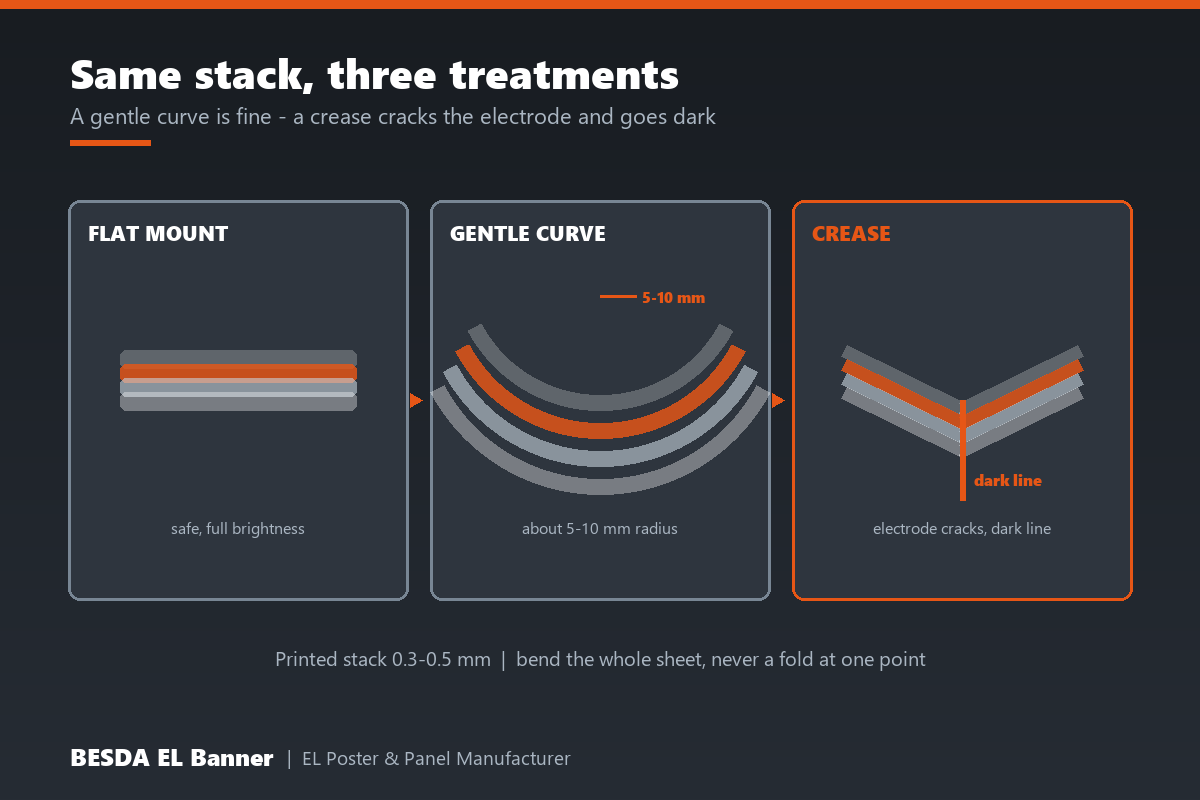
The electrode is the brittle part. The transparent ITO layer conducts across the whole face, and it is a ceramic film on plastic. It tolerates a gentle curve and fails at a crease. When it cracks, the phosphor above it stops receiving field in that strip, and the result is a thin dark line that no amount of power will fix.
The neutral axis is the design tool. In a laminated stack, some layers sit in tension and some in compression when bent. Keeping the ITO near the neutral axis – the plane that neither stretches nor compresses – is what allows a tighter radius without cracking. That is a lamination decision, and it is why two posters at the same thickness can have different bend limits.
The bus bar is stiffer than the rest. Silver paste tracks resist bending more than the phosphor and dielectric around them. A shape whose bus bar runs around a tight corner concentrates stress exactly where the conductor is thinnest, which is why our guide to custom shape builds treats the bus bar route as a design constraint, not a detail.
Heat is not the problem, moisture is. EL runs cold, so a bent build does not cook itself. What attacks a curved edge is moisture wicking into a cut or a lifted lamination. A sealed edge on a gentle curve lasts; an open edge on the same curve delaminates.
Curved cooler doors and bottle coolers. The most common request. A gentle radius of tens of centimetres is comfortable for a 0.3-0.5 mm build, and the piece follows the door without a frame.
Bottle and pack wraps. Sticker-thin builds wrap a cylinder when the cylinder is large enough. Small bottles with a tight radius are a different job and usually need a flat label area instead.
Pillars, columns and rounded counters. A flat poster on a curved pillar leaves gaps at both edges. A flexible build curves around the surface and the light stays even.
Props and standees. Bends and folds in a prop are usually built by mounting flat pieces at an angle, not by folding one flexible panel. Folded panels crease; angled mounts do not.
Transport. Rolling is the practical flexibility benefit. A tube ships more cheaply than a flat carton and arrives with fewer dents, provided the roll diameter stays wide.
| Flat mount | Gentle curve | Wrap | |
|---|---|---|---|
| Typical surface | Wall, panel, frame | Cooler door, pillar, counter | Bottle, tube, large cylinder |
| Bend radius | None | Tens of centimetres and up | Large diameter only |
| Build | 0.3-0.5 mm, framed or taped | 0.3-0.5 mm, laminated | Sticker-thin, laminated |
| Fixings | Frame, standoff, tape | Even tape line plus edge trim | Adhesive backing |
| Risk | Lowest | Edge lift if the radius is tight | Creasing at the seam |
| Reuse | High – flat storage | Medium – store flat | Low – single surface |
The point of the table is that “flexible” spans three quite different jobs. A cooler door tolerates a curve the panel barely notices. A bottle wrap is a different product with different tooling. Asking for a flexible poster without naming the radius leaves the most important variable open.
| Situation | Verdict | Why |
|---|---|---|
| Cooler doors, pillars, rounded counters | DO IT | The surface is curved and the piece must follow it |
| Shipping to many stores by parcel | DO IT | Rolled at a wide diameter, cheaper and safer in transit |
| Gently curved kiosk or counter face | DO IT | A flat build would need masking and leave gaps |
| A sharp crease to make a corner | SKIP IT | The crease line cracks the electrode and goes dark |
| Repeated flexing in use, like a moving flap | SKIP IT | EL is flexible, not flexing – cracks appear in weeks |
| Cylinder tighter than about 5-10 mm radius | SKIP IT | Below the working radius the stack fails |
| Outdoor mounting with wind flutter | SKIP IT | Constant movement plus moisture is the worst case |
| Thick rigid encapsulation on a curve | SKIP IT | Rigid resin on a curved surface pulls the stack apart |
If two or more SKIP IT conditions apply, the honest recommendation is a flat build on a flat substrate, or a different light source. A creased poster fails in a way that looks like a manufacturing fault but is really a specification mismatch, and neither side enjoys that conversation.
1. Measure the radius, not the diameter. A photo of the mounting surface with a tape measure answers more than a paragraph of description. If the surface is flat, say flat.
2. Decide the fixing line. An even tape line around the perimeter spreads load. A single strip down the middle lets the edges lift on a curve.
3. Choose lamination for the environment. Wipe-clean venues and food areas need a sealed face. A dry indoor wall can take a lighter finish, which bends more easily.
4. Plan the connector exit and strain relief. The lead is the stiffest part of the build. Bending a poster at the connector is the most common way to lose a panel, so choose the exit point and leave a service loop.
5. Agree the storage method before the run. Flat cartons or tubes change the packing and the cost. Decide with the destination in mind, not after the goods are made.
6. Install from a template. A paper template taped in place, then the poster aligned to it, keeps the curve even and stops installers from creasing a corner to make it fit.
Store flat, in the carton. A stack of posters with nothing heavy on top survives a season. A bin of loosely rolled pieces does not, because the tight rolls sit at the bottom under weight.
Roll at a wide diameter when you must. Tubes are for transport, not for long-term storage. Roll with the printed face outward, wrap in paper, and never tape directly onto the lit area.
Keep heat and solvent away. A hot van or a solvent wipe on a laminated edge attacks the seal. Wipe with a soft damp cloth, dry immediately, and store away from direct sun.
Protect the connector end. Cap it, bag it, and keep it at the top of the carton. A crushed connector ends the life of an otherwise perfect poster.
If a poster does start to fade rather than crack, that is a different failure with a different cause – our dim-after-a-year checklist covers the diagnostic order. And if the question is which driver to pair with the build, the power supply comparison sets out battery, 12V, USB and mains.
Creasing to fit a carton. The fastest way to destroy a poster is to fold it once at the end of packing. It looks fine in the box and shows a dark line on site.
Bending at the connector. The lead and its solder joint do not flex. Leave a loop, fix the cable, and never use the wire to pull the poster into position.
Assuming thinner is always better. A very thin build on an outdoor curved surface flutters in wind and fatigues at the fixing points. Thickness should match the exposure.
Framing a curve. A rigid frame on a curved substrate fights the surface and lifts one edge. Use edge trim that follows the curve, or no frame at all.
Storing rolled for months. A long roll takes a set. The poster then refuses to lie flat on the wall, and installers compensate by creasing it.
| Feature | Advantage | Benefit |
|---|---|---|
| 0.3-0.5 mm printed stack | Follows gently curved surfaces | Fits cooler doors and pillars without gaps |
| Lamination on the face | Sealed, wipe-clean surface | Survives food areas and store cleaning routines |
| Bend radius about 5-10 mm | Known limit at the quoting stage | No creased posters arriving on site |
| Rolled at a wide diameter | Cheaper, safer parcel shipping | Multi-store rollouts without flat cartons |
| Written spec per order | Thickness and drive settings recorded | Reorders match the first run |
1. Direct factory source better control quality. Printing, lamination and wiring happen in our Foshan facility, so the thickness and seal we quote are the ones QC checks before packing.
2. 15+ years professional experience. Since the early 2000s we have built electroluminescent displays for beverage, FMCG and event clients, including curved mounts that had to survive a full season.
3. Smooth communication & fast response. Send the surface photo and the radius, and one named contact answers with a build recommendation within 1 hour, 24×7, in writing.
4. Small qty acceptable. Most custom EL products start from 5 pcs – test the curve on one door before any production commitment.
5. Cooperated with more than 100+ global brands. Clients across Europe, the Middle East and the Americas taught us the packing and mounting habits that keep thin builds alive.
6. Stable lead time & fast delivery. Sample within 7 days of mockup approval, standard runs 7-10 days, larger bulk 15-20 days – dates confirmed in writing before you pay.
The printed EL stack runs 0.3-0.5 mm. A finished poster adds artwork film and lamination on top, so the mounted piece is slightly thicker. We quote the exact total for your build in writing, because lamination choice changes it.
About 5-10 mm on a gentle curve, and the flatter the better. The limit is not the plastic layers, it is the transparent electrode, which cracks when the curve gets tight. Confirm the radius for your specific build before you design a curved mount.
No. EL is flexible, not flexing. It survives being curved into a mount and staying there, and it survives being rolled for transport at a large diameter. Repeated flexing in use eventually cracks the electrode and leaves dark lines.
Care is not the issue; geometry is. A crease concentrates stress in one line and that line goes dark. The same panel curved gently across its whole width is fine. Bend the whole sheet, never a fold at one point.
Flat, in the original carton, away from heavy weight and sharp edges. Large pieces travel rolled at a wide diameter, never folded. Keep them out of direct sun and away from heat and solvent, and keep the connector end protected.
Not directly. Brightness comes from drive voltage and frequency, lifespan from how hard the phosphor is driven. Thickness matters for handling, mounting and bend tolerance – and a thinner build needs more care in packing.
Thickness is a handling decision and the bend radius is an electrical one. Keep the printed stack in the 0.3-0.5 mm band, curve it gently across the whole sheet, never crease it, and protect the connector. If the surface needs a fold or constant movement, choose a flat build instead – that is the cheaper answer even when it sounds like less. Send the surface, the radius and the destination country through our contact page and you will have a build recommendation in writing within the hour.
Send the size, quantity and destination country. We reply within 1 hour with feasibility, MOQ and lead time in writing.
Reply within 1 hour, 24×7 online service · [email protected]
Tell us the product, size, quantity and destination country. Attach artwork if you have it.
