WhatsApp: +86 139 2872 8741
Email: [email protected]
Tel:
0086-757-8938 9313
0086-20-8938 9313
Address:
Caochang Industrial Area, Liguang Rd, Lishui, Nanhai, Foshan, Guangdong, China
Reply within 1 hour, 24x7 online service

WhatsApp: +86 139 2872 8741
Email: [email protected]
Tel:
0086-757-8938 9313
0086-20-8938 9313
Address:
Caochang Industrial Area, Liguang Rd, Lishui, Nanhai, Foshan, Guangdong, China
Reply within 1 hour, 24x7 online service
The problem in one line: suppliers use “EL panel” and “EL poster” loosely, so buyers order a bare glowing sheet when they wanted a finished graphic, or the reverse – and both mistakes cost a sampling round.
We manufacture both in our Foshan factory, and the difference is simple once someone states it plainly. This page compares the two builds side by side: structure, artwork, animation, brightness, power and the orders each one suits. If you want the physics first, see how an EL poster actually works; this page is about choosing the right build.
| Item | The short answer |
|---|---|
| Shared core | Both are printed electroluminescent sheets: phosphor layer, electrodes, substrate – the same glow and the same inverter drive |
| EL panel | A bare glowing sheet, cut to size or shape, with no printed design on the light face |
| EL poster | A finished product: artwork film laminated over the panel, with lit zones and a connector placed for the mount |
| Thickness | About 0.2-0.5 mm after lamination for both; both stick flat to doors, glass and walls |
| Brightness | 80-140 nits band on our line; new panels measure around 140 nits |
| Drive | Inverter steps 3V/5V/12V DC or mains up to roughly 100-200 V AC, 400-2000 Hz typical |
| Animation | Mainly a poster feature; a bare panel lights as one face unless zones are printed at production |
| Artwork | Panel: none on the light face. Poster: your layered AI or PDF file, printed and laminated |
| Order size | Low MOQ accepted on both; wholesale runs start from 5+ pcs, mixed sizes allowed |
| Honest limit | Both wash out in direct sun; both are built for dim and indoor light |
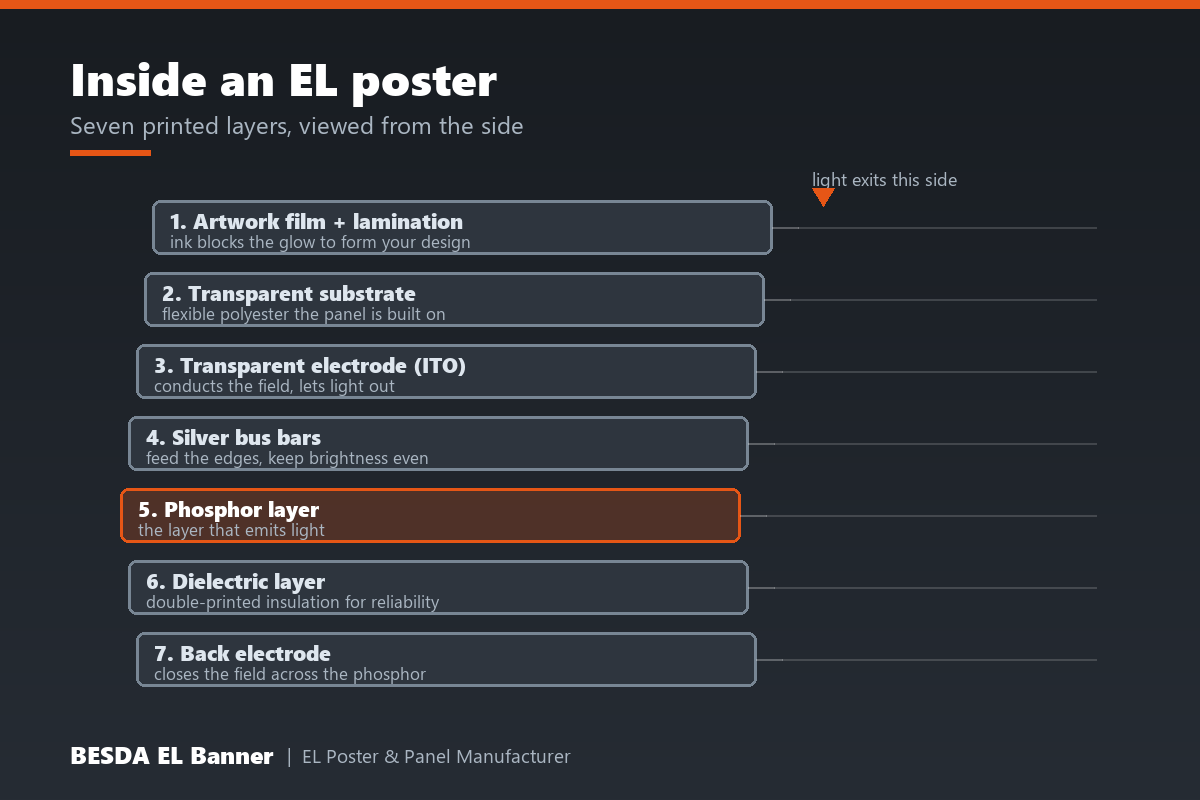
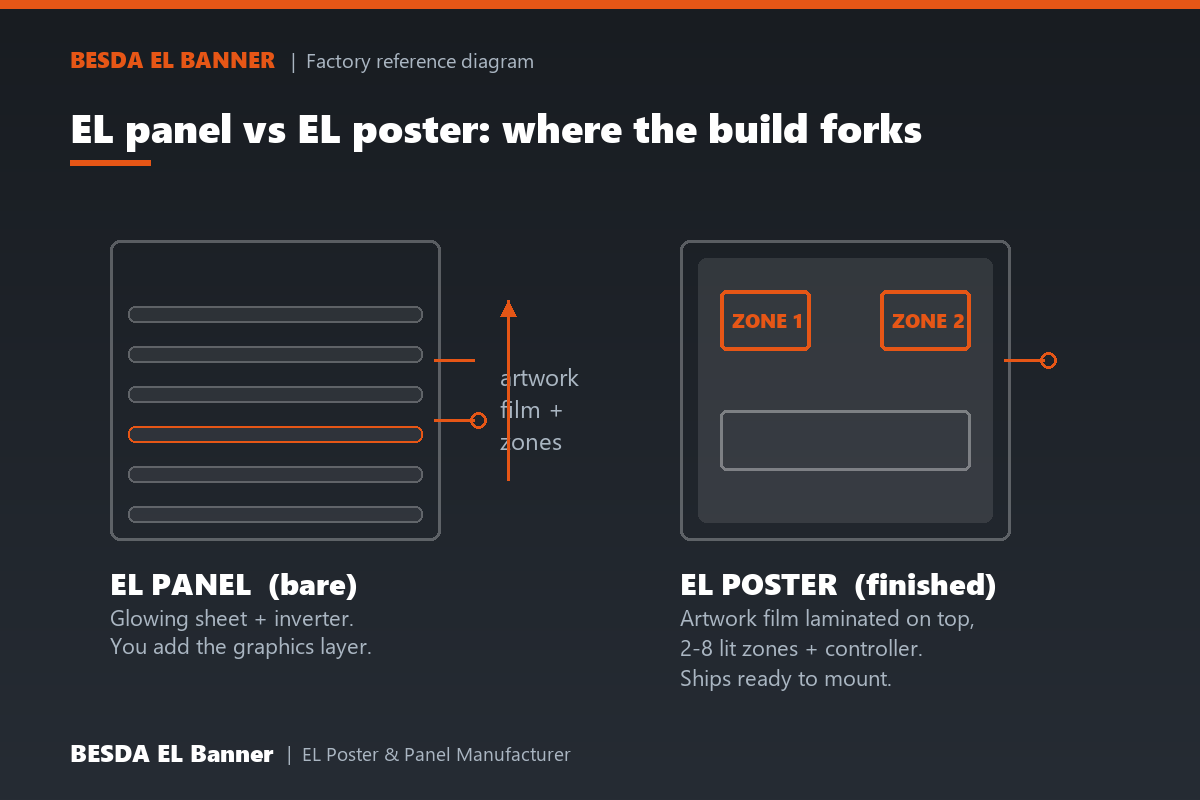
An EL panel is the raw glowing sheet. It is a printed stack – substrate, transparent electrode, phosphor layer, dielectric, back electrode – cut to the size or outline you ask for. Power it through an inverter and the whole face glows evenly, with no hot spots.
The light face carries no artwork. Whatever design appears is usually the glow itself, shaped by the cut: a rectangle behind a menu rail, a ring behind a bottle silhouette, an outline tracing a logo. Silver bus bars leave a 5-8 mm dead edge around the lit area, so the sheet is slightly larger than what lights up.
That bareness is the point. A panel is a light source you build with – behind printed graphics, inside a fixture, under a diffusion layer. If you plan to add your own print layer, a panel is what you buy. Our custom shape EL panels page shows how far the cutting can go.
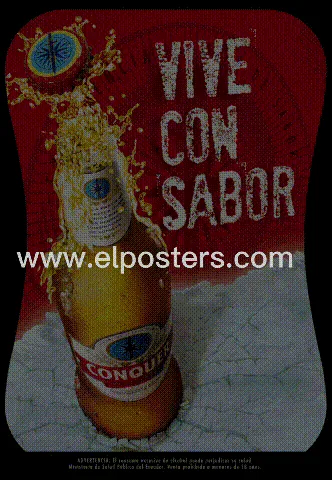
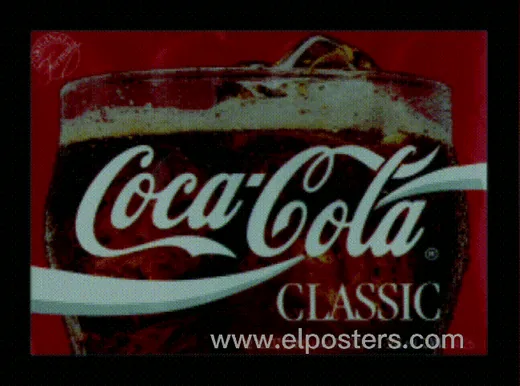
An EL poster is the finished product. The same glowing sheet sits under a printed artwork film, laminated into one sealed piece. Your design prints on top, and the poster reads as a bright silhouette of that design once the room dims.
A poster is also where animation lives. The print stage splits the lit area into 2-8 zones, each with its own feed, and a sequence controller switches them in order. Two zones can blink a price; five or more can walk light around a bottle. The zones are decided before production, on a numbered animation map you approve.
The poster arrives ready to mount: connector at the edge you asked for, inverter matched to the panel, artwork sealed against moisture. You can see the full picture on our custom EL posters page, including the standard size bands most first orders start from.
The two names get mixed up in search results, in quotes and sometimes inside the same supplier’s catalogue. That mixture creates three real problems:
1. A quoted product that cannot do the job. A buyer asks for an animated fridge display and gets priced a bare panel. A panel can be zoned, but the artwork layer, the zone map and the controller were never in the quote. The order restarts a month later.
2. Paying for a finish nobody needs. The opposite buyer already has printed faces and only needs a glow behind them. A finished poster would duplicate the print work. A bare panel is the cheaper, correct answer.
3. Comparing quotes that describe different things. One supplier’s “panel” includes lamination and one zone; another’s does not. Written specs settle it – thickness, artwork, zones, connector, inverter – before any deposit moves.
Production overlaps until the final third, which is why the names blur. Both builds start as screen-printed EL stacks, and both are die-cut to shape. The fork comes after curing:
Panel path. Cut to outline, seal the edges, attach the connector and lead at the position you specified, pair with an inverter, pack. One pass, no print layer.
Poster path. Add the artwork film with the lit-zone mask, laminate, wire each zone to the sequence controller, test the animation against the approved map, then pack with the inverter. Two more stages and two more approval points.
Power is identical downstream. An inverter takes 3V, 5V or 12V DC from a battery box, a USB port or a 12V rail – or mains through an adapter – and drives the sheet at roughly 100-200 V AC. Frequency options sit between 400 and 2000 Hz. The trade is brightness against lifespan, which our brightness explainer covers in numbers.
| Surface | Which build fits | Why |
|---|---|---|
| Behind your own printed graphic or stencil | Panel | You supply the design layer; the panel is the light source only |
| Fridge and cooler doors | Poster | Thin, sealed, battery-powered; artwork and glow arrive as one piece |
| Bar and club menu boards | Poster | Animated zones read across a dim room; staff swap posters in minutes |
| Window displays at night | Poster | Laminated face handles evening cool and damp; daylight exposure needs a check |
| Exhibition backwalls | Panel or poster | Tiled panels behind printed film, or posters direct – both ship flat |
| Instrument and shelf accents | Panel | Small glowing shapes where the graphic lives elsewhere |
| Prototyping and design studios | Panel | Cut and wire freely before committing to artwork tooling |
Same technology, two levels of finish. The rows below are the ones that actually decide orders.
| EL panel | EL poster | |
|---|---|---|
| What arrives | Bare glowing sheet plus inverter | Sealed artwork-and-panel product plus inverter |
| Artwork layer | None on the light face | Your design printed and laminated on top |
| Animation | One lit face unless zoned at print | 2-8 zones with a sequence controller, map approved first |
| Brightness | 80-140 nits band, even across the face | Same band; color filters on the film can trim output |
| Thickness | About 0.2-0.5 mm | About 0.2-0.5 mm including the laminated film |
| Shape freedom | Cut to outline with a 5-8 mm dead edge | Same cut, and the artwork follows the outline |
| Best role | Light source for your own build | Finished display ready to mount and run |
| Approval points | Outline and connector position | Outline, artwork proof, animation map, physical sample |
| Reorder speed | Fast – no artwork steps to repeat | Fast once file and tooling are on record |
| Feature (spec) | Advantage (what it does) | Benefit (what you get) |
|---|---|---|
| 0.2-0.5 mm laminated stack | Bends around doors, columns and glass within a 5-10 mm radius | Mounts flat where a light box cannot; no frame needed |
| 80-140 nits across the full face | Edge-to-edge glow with no hot spots | The message reads across the aisle in dim light |
| 2-8 animation zones | Motion without a screen, player or media file | Eyes stop at the display; the message gets seen first |
| 100-200 V AC drive, 400-2000 Hz | Drive matched to panel size and room light | Brightness fits the venue; lifespan is planned, not hoped |
| About 0.5-2 W per 100 cm² draw | Runs cool and stays safe to touch | Battery boxes work; no socket needed near the display |
| Cut to shape with 5-8 mm dead edge | Glow follows the logo outline, not a rectangle | The brand shape is the display |
| Wholesale from 5+ pcs, mixed sizes | Pilot one store or one event before bulk | Budget risk stays small on a first run |
| Sample within 7 days of mockup approval | Physical proof under real light and real power | Dates hold because nothing is guessed |
| Worth it when | Skip it when |
|---|---|
| Panel: you already have graphics and need thin, even light behind them | Panel: you expected a finished graphic – order a poster instead |
| Panel: cutting and wiring experiments during prototyping | Panel: one-off pieces with no reorder plan |
| Poster: the display must ship ready to mount and run | Poster: your print layer already exists inside the fixture |
| Poster: animation sells the message – zones, sequence, motion | Poster: the content changes weekly – that is a screen’s job |
| Either: the room is dim and the surface is thin or curved | Either: the wall takes direct sun for most of the day |
| Either: the run repeats across campaigns and stores | Either: a single weekend piece with no reuse planned |
The honest advice we give on every project: if the display faces direct daylight, EL is the wrong tool at any brightness we can print. That job belongs to an EL light box or an LED build, and we manufacture those too, so the recommendation does not tilt toward what we would rather sell.
1. Ask who owns the graphic. If a printed layer already exists in your fixture, you need a panel. If the glow and the design must live in one piece, you need a poster.
2. Ask whether anything should move. Static glow suits both builds. Sequence, blink or walking light means zones, and zones are a poster-stage decision.
3. Measure the surface, not the wish. Flat area, curvature, the 5-8 mm dead-edge allowance, connector side. Our size chart maps standard bands to fridges, shelves and windows.
4. Fix the power source with the installer. Battery box, USB, 12V or mains decides the inverter, the cable run and the mounting detail. The power supply comparison is worth reading before the artwork goes final.
5. Get the spec sheet in writing. Thickness, brightness band, zones, connector, packing – the same list for both builds, so quotes compare like with like.
Ordering a panel when the plan needed zones. Zoning a bare panel later means reprinting it. Decide animation before the cut, not after the first sample.
Judging brightness on a desk in a lit office. 80-140 nits reads well in dim light and poorly under office fluorescents. Test the sample where it will live.
Ignoring the dead edge. The lit area is smaller than the sheet by 5-8 mm per side. Artwork that runs to the paper edge gets clipped by the bus bars.
Splitting the inverter from the panel’s spec. A mismatched drive changes brightness and shortens life. The panel and its inverter ship as one matched system.
Forgetting the daylight hours. A bar looks perfect at 21:00 and invisible at 14:00. Plan print or shading for daytime, or pick a different product for sunlit walls.
1. Direct factory source, better quality control. Panels are printed, laminated and wired in our Foshan facility. No trading layer between you and the line, so a spec change reaches the operator the same day instead of a week later.
2. 15+ years professional & expert experience. We have been producing electroluminescent displays since the early 2000s for beverage, FMCG and event clients. That history is why we can tell you in the first call whether your idea will print cleanly.
3. Smooth communication & fast response. One named contact handles your order from quote to shipping. We reply within 1 hour, 24×7, and we answer in writing so nothing depends on a phone call you cannot forward to your team.
4. Small qty acceptable. Most custom EL products start from 5 pcs. You can test a market, a single store or one event before committing to a production run.
5. Cooperated with more than 100+ global brands. Work from beverage, cosmetics, telecom and retail clients across Europe, the Middle East and the Americas has taught us the artwork and compliance quirks of each market.
6. Stable lead time & fast delivery. Production slots are booked when your deposit lands, and the sampling and bulk dates are confirmed in writing. If a deadline is unrealistic we say so before you pay, not after.
The glowing core is the same printed EL stack. A panel is the bare sheet you build with; a poster adds your artwork film, lamination and, on request, 2-8 animation zones. Same technology, different levels of finish.
A poster. The fridge build wants a sealed artwork face, a battery box and a connector at the hinge side, all in one piece. A bare panel suits you only if you already print your own graphics.
Yes. Both are die-cut to the same outlines, with a 5-8 mm unlit edge where the bus bars run. The difference is only whether a printed design sits on the lit face.
Yes, both measure in the 80-140 nits band on our line. Color filters in a poster’s artwork film can trim output slightly, which we state in the written spec before sampling.
Zones can be printed into a panel, but sequencing, the zone map and the controller belong to the poster stage. If motion matters, order it as a poster and approve the animation map first.
Low MOQ accepted. Wholesale runs start from 5+ pcs and mixed sizes are allowed in one run. Sampling ships within 7 days of mockup approval; dates are confirmed in writing before you pay.
A panel is a light source. A poster is a display. Both glow at 80-140 nits, both bend where frames cannot, and both earn their keep in dim rooms. Choose the panel when your graphics already exist; choose the poster when the artwork, the zones and the mount should arrive solved. Tell our team the surface, the quantity and the destination through the contact page, and the answer comes back in writing within the hour.
Send the size, quantity and destination country. We reply within 1 hour with feasibility, MOQ and lead time in writing.
Reply within 1 hour, 24×7 online service · [email protected]
Tell us the product, size, quantity and destination country. Attach artwork if you have it.