WhatsApp: +86 139 2872 8741
Email: [email protected]
Tel:
0086-757-8938 9313
0086-20-8938 9313
Address:
Caochang Industrial Area, Liguang Rd, Lishui, Nanhai, Foshan, Guangdong, China
Reply within 1 hour, 24x7 online service

WhatsApp: +86 139 2872 8741
Email: [email protected]
Tel:
0086-757-8938 9313
0086-20-8938 9313
Address:
Caochang Industrial Area, Liguang Rd, Lishui, Nanhai, Foshan, Guangdong, China
Reply within 1 hour, 24x7 online service
The honest line first: an EL poster is an 80-140 nit light source, and a sunlit white wall can reflect more than 2,500 nits. No artwork closes that gap. Position, timing and expectations do.
We manufacture EL posters in Foshan, and this is the conversation we have before most window orders. Buyers arrive with a brief written for an LED light box, then see an EL sample at noon and assume something is wrong. Nothing is wrong. The numbers simply describe a different job. This page sets out the photometry in plain terms, the conditions where the glow holds, and the cases where we recommend against EL. For the retail buying side, the window buyer’s brief covers sizing and installation.
| Item | What we confirm in writing |
|---|---|
| Panel luminance | 80-140 nits measured on our line |
| What visibility depends on | Panel luminance against the luminance of its surround |
| White wall at 2,000 lux | About 500 cd/m2 reflected, typical for a diffuse surface |
| Comfortable glow | Ambient below about 200 lux, typical |
| Best conditions | Under 50 lux with a dark background |
| Daylight verdict | A lit graphic, not a dominant sign |
| Colour behaviour | Aqua-white is brightest; filter layers reduce output |
| Glass effect | Clear float glass reflects roughly 4-8% of the scene |
| Lifespan | 8,000-25,000 hours to half brightness, conditions stated |
| Certificates and lead time | CE, FCC, RoHS on request; sample within 7 days |
Two measurements sit behind every argument about brightness. Luminance, in nits or cd/m2, describes light leaving a surface toward your eye. Illuminance, in lux, describes light arriving at a surface. A poster is specified in nits. A room or a street is specified in lux.
Visibility is not a property of the poster alone. Your eye compares the poster with whatever fills the rest of the view. Put a 120-nit panel against a dark bar wall and it glows. Put the same panel against a white wall reflecting 500 cd/m2 and it looks like tinted paper.
That is why two buyers can test the same product and disagree. One tested at 20:00 in a dim window. The other tested at 14:00 behind glass facing the street. Both reports are honest. Only one of them describes the campaign.
Colour adds a second channel. Even when the luminance ratio falls below 1:1, a saturated aqua or orange patch still reads as colour against a neutral grey scene. Hue contrast outlives brightness contrast, which is why a well-designed EL poster stays recognisable in a bright window while its glow fades.
Briefs are written for LEDs. A brand team asks for a “bright glowing window sign” and pictures a backlit box. The EL quote arrives, the sample looks soft at noon, and the agency thinks the factory underdelivered.
Photos mislead both ways. A phone exposes for the glow, so the room darkens and the poster looks strong. Send that photo to a client and you have promised an effect the window will not deliver at 13:00.
Daytime is when most people walk past. A poster that only performs after 19:00 still has value, but the media plan should say so. Footfall at noon is not the same audience as footfall at night.
Returns start with mismatched expectations. The cheapest fix is a five-minute conversation about lux, nits and the hour of the test. It costs nothing and prevents most disputes.
The alternative has a different budget. If daylight dominance is the real requirement, a light box or an LED display is the right product. We say that early rather than sell the wrong panel.
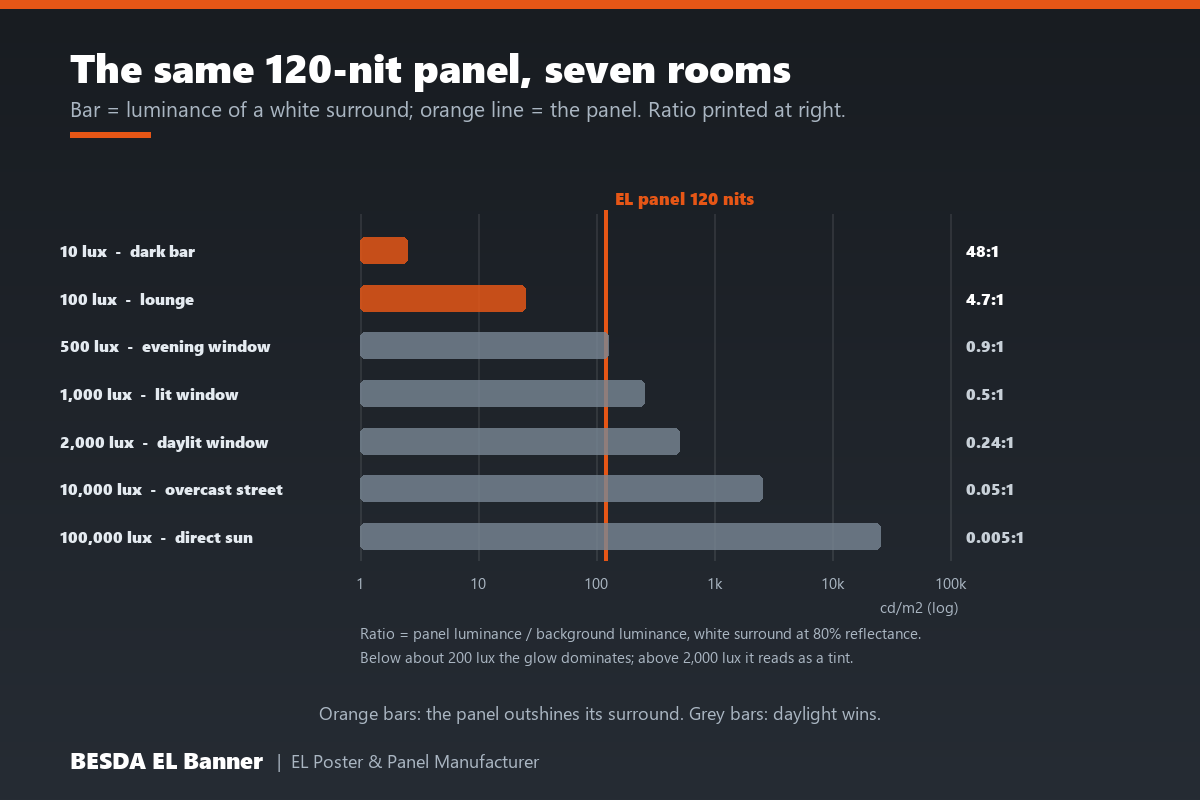
A diffuse white surface reflects roughly its illuminance times its reflectance, divided by pi. At 80% reflectance, the arithmetic is simple enough to do in a meeting. The table below uses a 120-nit panel and a white surround, which is the worst realistic case for contrast.
| Ambient light | White surface luminance | 120-nit panel / background | What a viewer sees |
|---|---|---|---|
| 10 lux | About 2.5 cd/m2 | About 48:1 | The glow owns the scene |
| 100 lux | About 25 cd/m2 | About 4.7:1 | Clearly lit, easy to read |
| 500 lux | About 127 cd/m2 | About 0.9:1 | A soft tint; works with a dark surround |
| 1,000 lux | About 255 cd/m2 | About 0.5:1 | Glow visible only up close |
| 2,000 lux | About 509 cd/m2 | About 0.24:1 | Washed out in a bright window |
| 10,000 lux | About 2,546 cd/m2 | About 0.05:1 | Glow almost gone |
| 100,000 lux | About 25,465 cd/m2 | About 0.005:1 | No perceptible glow |
Three adjustments change the picture. A darker surround lowers the background luminance and restores local contrast. Shade removes the brightest competitor from the scene. And a shaded viewing position lets the eye adapt down, which is why a poster under an awning reads better than the same poster in open sun.
Glass sits on top of all this. A clear pane reflects roughly 4-8% of the street scene toward the viewer, and at eye level that reflection lands on the poster. Tilt the panel, move it back from the glass, or accept that the mirror image is part of the design.
| Environment | Typical light level | What the viewer sees | Verdict |
|---|---|---|---|
| Dark bar or club interior | 20-50 lux | The panel is the brightest object in view | Excellent |
| Evening shop window | 500-1,000 lux | Clearly lit, reads from the pavement | Good |
| Daylit shop window | 1,500-3,000 lux | A lit tint competing with accent lights | Fair, position carefully |
| Covered arcade or shaded glass | 300-800 lux | Glow reads well through the day | Good |
| Overcast street | 5,000-10,000 lux | Soft glow visible only up close | Poor |
| Direct sun on the glass | 50,000-100,000 lux | No perceptible glow | Not suitable |
| Attribute | EL poster | LED light box |
|---|---|---|
| Face luminance | 80-140 nits typical | 3,000-10,000 nits typical |
| Daylight contrast | Low; reads as a tint | High; holds against window light |
| Evening look | Soft, even, no glare | Bright and graphic |
| Thickness | 0.3-0.5 mm | 25-60 mm plus frame |
| Heat at the face | Near room temperature | Warm back panel |
| Animation | 2-8 lit zones in sequence | Limited; needs extra hardware |
| Power | Battery, USB, 12V or AC | Mains, higher draw |
| Best use | Night venues, shaded windows, motion | Daylight windows, large faces |
| Situation | Verdict | Why |
|---|---|---|
| Evening window or night venue | WORTH IT | The panel is the brightest thing in view |
| Covered arcade, north-facing glass | WORTH IT | Ambient stays workable through the day |
| Indoor display away from windows | WORTH IT | Room light is well below the glow threshold |
| Festival or event after dusk | WORTH IT | Dark surround, strong colour, low power |
| High-street window as the daytime hero | SKIP IT | Daylight outruns 80-140 nits every time |
| South-facing glass in summer | SKIP IT | Heat and UV shorten life and wash the glow |
| Outdoor pavement sign in weather | SKIP IT | Unsealed edges fail; brightness is hopeless |
| Sign must beat direct sun | SKIP IT | Use a light box or an LED display |
| Video content is required | SKIP IT | EL sequences zones; it does not play video |
1. Measure the worst hour, not the best. Take a lux reading at 13:00-15:00 at the poster plane. If that number is above 2,000 lux, plan for a tint rather than a glow.
2. Move the poster deeper into the window. Setting it 200-400 mm back from the glass removes the direct sun path and cuts the specular reflection at eye level.
3. Give it a dark surround. A charcoal or deep-colour backing lowers the local background luminance. The panel does not get brighter; the contrast around it does.
4. Design for hue and edges. Saturated fields, thick strokes of 3-4 mm at final size, and strong silhouettes survive bright conditions. Pastel gradients on white do not.
5. Ask for the drive preset that matches the hours. A harder drive buys output and spends lifespan. For a two-week campaign that trade can make sense; for a permanent install it usually does not.
6. Time the lighting. A timer that switches on at dusk and off at close saves lit hours and puts the glow where the audience is. On-off cycling adds no wear.
7. Change product if daylight dominance is the brief. A light box is the honest answer for a sunlit high street. We will quote one rather than force an EL panel into a job it cannot do.
Comparing nits with lumens. They measure different things. A 3,000-lumen lamp and a 120-nit panel cannot be ranked on one scale, and the comparison hides the real question: what is the surround luminance?
Judging from a phone photo. Auto exposure flatters the glow and darkens the room. Judge with your eyes in the actual window at the actual hour.
Testing in winter and assuming summer. Low sun angles reach deeper into a window in June than in December. Test in the season the campaign will run.
Believing a whiter print is a brighter panel. The phosphor sets the ceiling. Printed white on top of it filters light rather than adding it.
Ignoring the glass. Tinted glass cuts transmission, reflective glass adds a mirror, and dirty glass scatters. All three change the result more than a drive preset does.
Promising a client a “glowing sign” without numbers. Quote the panel nits, the window lux and the hour of the test. Honest numbers win the second order.
| Feature | Advantage | Benefit |
|---|---|---|
| 80-140 nits, quoted with conditions | A number you can compare against window lux | No surprises when the sample meets daylight |
| Measured 140-to-80 fade curve | Softening described from our own line | Clients know what year three looks like |
| 0.3-0.5 mm laminated panel | Fits behind glass with no cavity | Window depth stays with the merchandise |
| 2-8 lit zones with a controller | Sequence draws the eye at dusk | Motion without a screen or a video wall |
| Battery, USB, 12V and AC builds | Power where no socket exists | Campaigns start without an electrician |
| Sample within 7 days | Test in the real window before bulk | Decide at the hour that matters |
1. Direct factory source better control quality. Printing, lamination, zone wiring and QC happen in our Foshan facility, so the drive preset we quote is the one QC checks.
2. 15+ years professional experience. Two decades of electroluminescent production taught us when to recommend a different product.
3. Smooth communication & fast response. One named contact handles your order, and we reply within 1 hour, 24×7, in writing.
4. Small qty acceptable. Most custom EL products start from 5 pcs, enough to test one window before a chain order.
5. Cooperated with more than 100+ global brands. Campaigns across Europe, the Middle East and the Americas shaped how we explain light levels.
6. Stable lead time & fast delivery. Sample within 7 days of mockup approval, standard runs 7-10 days, larger bulk 15-20 days, confirmed in writing.
Because the panel is a fixed 80-140 nit light source and daylight sets a much higher bar. A white wall at 2,000 lux reflects about 500 cd/m2. The glow is still there; the room is simply brighter than the panel. That is physics, not a fault.
A harder drive preset raises output, and it spends lifespan to do it. Colour choice matters too: aqua-white is the brightest phosphor, while filtered colours start lower. Even pushed hard, EL stays far below a backlit box.
Not as a readable sign. Shade, overcast light and dusk are workable; direct sun is not. Weather protection is a separate question, and an unsealed edge will fail long before the hours do.
Yes, in two ways. Tinted glass cuts the light that reaches the poster, and reflective coatings add a mirror image on top of it. Test behind the actual glass before you commit to a rollout.
Below about 200 lux the glow dominates. Between 500 and 1,000 lux it reads as a clearly lit graphic if the surround is dark. Above 2,000 lux it becomes a tint rather than a light.
Show a sample at the real hour and state both numbers: panel nits and window lux. If the brief needs daylight dominance, say so early and quote a light box instead. That conversation protects the campaign.
Daylight is not an EL poster’s stage. At 80-140 nits it reads as a lit graphic in a shaded window and as a coloured tint in a bright one. After dusk, against a dark surround, it is the brightest object in the frame. Specify by numbers, test at the hour that matters, and use a light box where daylight dominance is the real requirement. Send us the window lux readings and the campaign hours through our contact page; within the hour you will have an honest verdict, a drive preset and lead times in writing.
Send the size, quantity and destination country. We reply within 1 hour with feasibility, MOQ and lead time in writing.
Reply within 1 hour, 24×7 online service · [email protected]
Tell us the product, size, quantity and destination country. Attach artwork if you have it.
