WhatsApp: +86 139 2872 8741
Email: [email protected]
Tel:
0086-757-8938 9313
0086-20-8938 9313
Address:
Caochang Industrial Area, Liguang Rd, Lishui, Nanhai, Foshan, Guangdong, China
Reply within 1 hour, 24x7 online service

WhatsApp: +86 139 2872 8741
Email: [email protected]
Tel:
0086-757-8938 9313
0086-20-8938 9313
Address:
Caochang Industrial Area, Liguang Rd, Lishui, Nanhai, Foshan, Guangdong, China
Reply within 1 hour, 24x7 online service
The problem in one line: a nightclub runs its show on high-output fixtures, but the surfaces guests touch, read and photograph live in 30-120 lux. That is where electroluminescent panels earn their place.
We manufacture EL posters, panels and stickers in Foshan, and venue designers ask us one question in every project. Where does EL actually belong in a club, and where should we not pretend it works? This guide answers both halves honestly. It maps the panels against the lighting layers of a venue, and it gives the fit and the skip list. It ends with a spec sheet you can send to a fabricator. For the honest brightness limits behind one claim here, see our daylight visibility guide.
| Item | Typical value |
|---|---|
| Role in the venue | Accent layer: glowing surfaces, not beams |
| Panel brightness | 80-140 nits typical; new BESDA panels start near 140 |
| Venue ambient | 30-120 lux in bar and lounge zones after dark |
| Panel thickness | 0.25-0.55 mm; mounts flat with tape or standoffs |
| Surface temperature | Cold light; near room temperature at full power |
| Power input | AC adapter, shared 12 V feed, or battery box |
| Animation | 2-8 lit zones in sequence; sound-activated trigger available |
| Camera behaviour | Even glow on normal footage; banding possible at high shutter speeds |
| Bespoke shapes | Vector cut line, minimum glow width confirmed per design |
| Lead time | Sample within 7 days of mockup approval; bulk 15-20 days |
Venue lighting comes in three layers. Ambient light fills the room; in bars and clubs that base sits around 30-120 lux depending on the zone and the hour. Task light serves the bar top and the POS, and accent light sells the brands, marks the VIP sections and gives the room its identity.
The show layer is already taken. Moving heads, strobes, lasers and LED video own the dance floor, and they are driven from a lighting desk with frame-level control. EL does not compete here, and any supplier who claims it does is selling the wrong medium.
The accent layer is under-served. Bottle displays, menu faces, entry signs and booth fronts need to glow flat, run silent, stay cool and survive a night of guests. That is a surface problem, not a beam problem, and it is the natural habitat of an EL panel.
The guest layer is physical. People lean on bar fronts, brush past walls, wear the merch and hold the bottles. Any glowing surface at guest level must run cool and low voltage. A panel that radiates heat or needs mains at the touch point fails the room before it fails the inspection.
| Surface | Fit | Why it works |
|---|---|---|
| Bottle and glass stickers | ★★★★★ | Thin battery-lit labels; cold surface touches the bottle |
| Bar front and counter fascia | ★★★★★ | Flat sheet follows the counter line; readable at 1-3 m |
| VIP booth walls and screens | ★★★★ | Custom shapes and 2-8 zones; dark zone keeps it private |
| Entry and ticket-wall signage | ★★★★ | Reads from 3-6 m in the darkest part of the room |
| DJ booth trim and fascia | ★★★★ | Butted panels wrap the desk; driver hides in the plinth |
| Staff and promo apparel | ★★★★ | Battery packs drive EL shirts and caps; cold on skin |
| Restroom and corridor wayfinding | ★★★☆ | Rooms without fixtures still need legible signs |
| Coat and merch counter headers | ★★★☆ | Narrow strips mark the point of sale without glare |
Power runs three ways. Fixed builds take an AC adapter or a shared 12 V feed, which keeps the driver hidden and the wall clean. Wearables and movable pieces run battery boxes sized to the panel area. The full trade-offs sit in our power supply comparison.
Animation is zonal, not video. A sequence controller lights 2-8 zones in order, which is enough for a logo that builds, a bottle that fills or a wall that ripples. Sound-activated modules add a bass trigger, so the graphic moves with the low end without any programming. The mechanics are in our zones and controllers guide.
The surface stays cold. EL is a capacitive cold-light layer drawing phone-charger-level power per panel. A sticker on a bottle or a sheet on a bar front warms neither the drink nor the wrist. This single property decides more venue placements than brightness ever will.
Cameras need one honest caveat. On normal footage the even glow reads cleanly. At high shutter speeds the drive frequency can show as rolling bands. Venues that film their nights should state it up front so the drive settings are confirmed per project before the build.
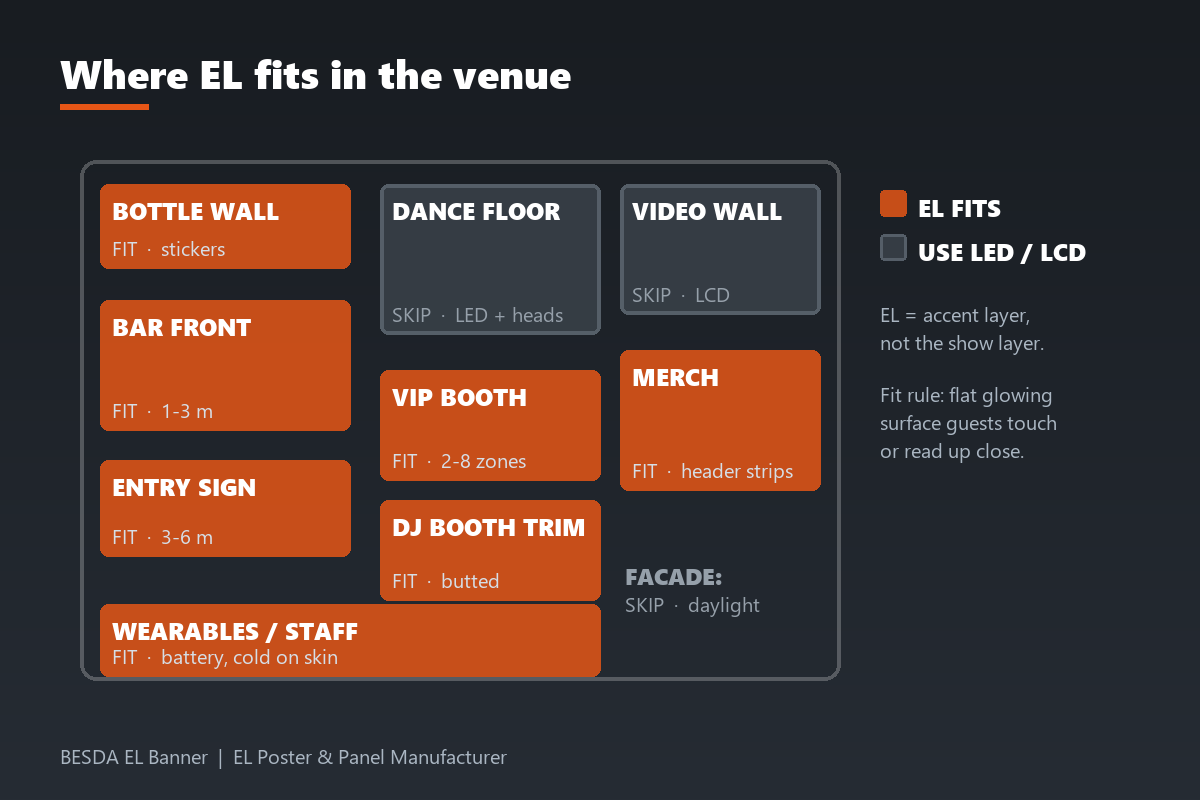
Dance floor and show lighting. An EL panel puts out 80-140 nits of even sheet light. A club floor wants moving beams and thousands of nits. If the question is about lighting people, the answer is LED fixtures, not EL.
Frame-accurate show sync. Zone sequences run from a small controller or a bass trigger. They are not DMX fixtures. If the cue must land on a specific beat every time, drive the zones from the lighting desk. The alternative is to accept the approximate rhythm of the sound module.
Outdoor facades and big external logos. EL loses contrast fast under daylight and needs a sealed, protected build outdoors. The daylight visibility guide gives the numbers; the short version is that EL is an indoor and after-dark medium.
Video content. EL animates zones, it does not play frames. Anything that looks like footage belongs on an LED wall or an LCD screen. The earlier the brief says so, the cheaper the project stays.
Wet and high-abrasion zones. The panel face is laminated, but standing water, steam and scrubbing are beyond a standard build. Splash-zone installations need a sealed construction confirmed per project, and high-touch surfaces should sit behind a protective layer.
| Attribute | EL panel | LED fixture | Blacklight paint | LCD screen |
|---|---|---|---|---|
| Output | Even sheet, 80-140 nits | Beams and wash, very bright | Glow only under UV lamps | Full video, very bright |
| Best job | Glowing surfaces guests touch | Show, floor and facade | Mural-style art walls | Video and motion content |
| Thickness | 0.25-0.55 mm flat | Fixtures and cabling | Paint layer | Screen depth and mount |
| Heat at surface | Cold light | Fixture heat | Lamp heat | Screen heat |
| Animation | 2-8 zones in sequence | Fixture movement | None | Full video |
| Runs silent | Yes, faint hum at arm range | Fan noise on some units | Yes | Yes |
| Power draw | Phone-charger level | High | Moderate (UV lamps) | High |
| Guest-level safe | Yes, low voltage DC | Needs rigging and guards | Yes | Needs mounting |
| Indoor after dark | Ideal | Ideal | Ideal | Ideal |
| Daylight use | Weak; honest limit | Strong | Invisible until lit | Strong |
| Situation | Verdict | Why |
|---|---|---|
| Bottle or bar-front branding that glows flat | WORTH IT | The core fit: thin, cool, silent, readable |
| VIP and booth surfaces with custom shapes | WORTH IT | Cut panels follow the joinery design |
| Staff shirts and promo wearables | WORTH IT | Battery driven, cold on skin, laundry-safe by hand wash |
| Entry signage in the darkest zone | WORTH IT | Reads at 3-6 m without glare |
| Bass-triggered graphics over the bar | WORTH IT | Sound module fires zones on the low end |
| Dance floor or facade lighting | SKIP IT | Brightness and control belong to LED fixtures |
| Frame-accurate beat-synced cues | SKIP IT | EL zones are not DMX instruments |
| Video or photographic motion | SKIP IT | EL sequences areas; screens play frames |
| Steam rooms, wash-down or outdoor walls | SKIP IT | Sealed builds are possible but confirmed per project |
1. Split the room into layers first. Decide which surfaces belong to the accent layer before choosing any technology. EL enters only when the question is a glowing surface, not a beam or a video.
2. List each surface with its reading distance. Bar front at 1-3 m, entry at 3-6 m, bottle labels at arm length. Distance sets the size and the glow-line weight, the same way it sets type on any sign.
3. Mark the zones and the trigger. Count how many areas should light independently, from 2 up to 8, and decide whether a sequence controller or a sound-activated module drives them. Send the zone map with the artwork.
4. Plan power with the fabricator. Say which panels are fixed and which move. Fixed surfaces take adapters or a shared 12 V feed; wearables take battery boxes. State cable exit sides so the joinery hides them.
5. Check the film and camera plan. If the venue films content, flag it. Drive settings that look smooth to the eye can band on camera, and the fix belongs in the spec, not in post-production.
6. Approve a lit sample in situ. Mockup approval starts a sample within 7 days. Read it in the actual room, at the actual distance, under the actual lighting state, before the full run is booked.
Asking EL to do the show. Panels bought for floor lighting disappoint everyone. The room ends up buying LED fixtures anyway, and the EL budget would have bought a better bar front.
No zone map in the artwork. A brief that says the logo should pulse is not a build instruction. Zones need numbers, an order and a schedule on paper, or the first sample becomes a guessing game.
Battery sizing skipped. A wearable panel draws little power, but the driver has a floor draw, and an undersized pack dies mid-shift. State the panel area and the operating hours, and the pack is sized in the quote.
Seams ignored on large walls. Big surfaces are built from butted sections, and unplanned seams cut a logo through the middle. Design the breaks into the artwork from the start.
Cables across service routes. Behind a bar, a cable crossing a walkway is a hazard and an inspection note. Plan the exit side and the raceway before production.
| Feature | Advantage | Benefit |
|---|---|---|
| Cold-light surface | Touch-safe at guest level | Bottles, walls and wearables without heat risk |
| 0.25-0.55 mm sheet | Wraps counters, booths and bottles | Accent glow where fixtures cannot sit |
| 2-8 zones + sound trigger | Graphics move with the room | Branded moments without a media budget |
| Battery to 12 V to AC | One family covers walls, bars and wearables | Fewer vendors for the fit-out |
| Cut-to-shape production | Glow follows the design outline | Booth fascias and logos built as surfaces, not frames |
| Sample in 7 days | Design is tested in the real room | No surprises during the fit-out week |
1. Direct factory source better control quality. Panel printing, lamination, zone wiring and lit QC happen in our Foshan facility, so a venue build is specced by the people who produce it.
2. 15+ years professional experience. We have supplied electroluminescent displays to beverage and nightlife programmes since the early 2000s, including bottle stickers, bar fascias and promo wearables.
3. Smooth communication & fast response. One named contact handles spec, artwork and shipment, and we reply within 1 hour, 24×7, in writing.
4. Small qty acceptable. Custom panels and stickers start from 5 pcs, so a single room, a pop-up night or one test booth can order without a bulk commitment.
5. Cooperated with more than 100+ global brands. Campaign surfaces built with agencies and beverage programmes across Europe, the Middle East and the Americas shaped this guide.
6. Stable lead time & fast delivery. Sample within 7 days of mockup approval, standard runs 7-10 days, bulk 15-20 days, all confirmed in writing against your fit-out schedule.
In the accent layer, not the show layer. Bottle stickers, bar fronts, VIP walls, entry signage, DJ booth trim and staff shirts all suit a flat glowing sheet. Dance floors, laser lines and beat-synced beams belong to LED and moving-head fixtures.
Sound-activated drivers exist: a small module triggers the next zone on low-frequency hits, so a logo or bottle graphic pulses with the bass. It is a rhythm effect, not a DMX beat cue; for frame-accurate sync, drive the zones from your show controller instead.
The panel is a cold-light surface and stays near room temperature, so it cannot warm a bottle or burn a wrist. The input side is low-voltage DC through the driver. The panel face is laminated, but it is not a wet-area product, so splash zones need a sealed build confirmed per project.
A flat, even glow photographs cleanly in normal venue lighting. At high shutter speeds the panel can show banding, because the drive frequency interacts with the camera. If the night will be filmed, tell us and we confirm the drive settings per project.
Three routes: an AC adapter per panel, a shared 12 V feed from venue equipment, or battery boxes for wearables and movable pieces. Most venues mix all three, and the driver hides behind the surface it lights.
Panels run as sheets and shapes, and large areas are built from butted sections with seams planned into the design. Custom outlines follow a vector cut line with a minimum glow-line width. A booth fascia or a wall-sized logo becomes a drawing exercise, not a fixture build.
A nightclub does not need another show-lighting technology. It needs its surfaces to glow flat, run cool and survive guests, and that is a sheet-goods job. Put EL panels on bottle stickers, bar fronts, booth walls, entry signage and staff wearables. Keep them off the dance floor, the facade and anything that plays video. Send us the surface list and room plan through our contact page. We will mark which surfaces EL fits, which it does not, and the lead times in writing.
Send the size, quantity and destination country. We reply within 1 hour with feasibility, MOQ and lead time in writing.
Reply within 1 hour, 24×7 online service · [email protected]
Tell us the product, size, quantity and destination country. Attach artwork if you have it.
