WhatsApp: +86 139 2872 8741
Email: [email protected]
Tel:
0086-757-8938 9313
0086-20-8938 9313
Address:
Caochang Industrial Area, Liguang Rd, Lishui, Nanhai, Foshan, Guangdong, China
Reply within 1 hour, 24x7 online service

WhatsApp: +86 139 2872 8741
Email: [email protected]
Tel:
0086-757-8938 9313
0086-20-8938 9313
Address:
Caochang Industrial Area, Liguang Rd, Lishui, Nanhai, Foshan, Guangdong, China
Reply within 1 hour, 24x7 online service
The problem in one line: a bar menu has to stay readable at 30-120 lux without turning into a glare source. That narrow window is exactly where an EL poster works best.
We manufacture electroluminescent posters in Foshan, and hospitality buyers ask one question more than any other: will guests actually read it in the dark? This guide answers that with numbers. It covers how EL poster brightness behaves against low ambient light, and what the panel does and does not do. Then it shows how to size a menu board for a real counter. If your venue needs a framed, swappable face, the EL light box comparison is the companion read.
| Item | Typical value |
|---|---|
| What it is | A printed graphic laminated onto a 0.3-0.5 mm electroluminescent panel with a driver |
| Panel brightness | 80-140 nits typical; our new panels start at about 140 nits |
| Bar ambient light | 30-120 lux after dark, venue dependent |
| Reading distance | Menu boards 2-4 m; table cards 0.5-1 m |
| Headline cap height | About 17 mm at 2 m, 25 mm at 3 m for comfortable reading |
| Panel thickness | 0.25-0.55 mm, so it mounts flat against timber, tile or glass |
| Power input | USB, battery box, 12 V or AC adapter |
| Heat output | Near zero; the panel is a cold-light surface |
| Glow life | 8,000-25,000 hours to half brightness, gradual fade |
| Sample lead time | Within 7 days of mockup approval; runs 7-10 days; bulk 15-20 days |
An EL poster is a sandwich. The front film carries the printed menu, and a laminate protects it. Behind the print sit the light layers: a clear PET base, transparent electrodes, the phosphor layer, and a rear electrode. The whole stack is 0.25-0.55 mm thick, which is why it mounts flush where a light box cannot.
The panel glows, the print decides what you read. The phosphor layer emits a flat sheet of light, and the printed ink on top blocks or passes it. Dark ink on a lit field is what makes a menu legible, the same way dark type reads on white paper.
One poster is one sealed unit. The graphic and the light layer are laminated together, so a menu update means printing a fresh poster. There is no channel to slide paper into; that job belongs to the framed light box format. Repeat runs start from 5 pcs, so a seasonal reprint is a small order, not a project.
The driver is the only bulky part. A small inverter converts 5 V or 12 V DC into the AC the panel needs. It hides behind the counter or inside the frame. Everything else stays flat.
A menu board lives or dies on contrast. Contrast is a two-sided number: the brightness of the sign on one side, the ambient light on the other. Industry guidance for illuminated signs puts the comfortable ceiling for night-time viewing around 300-600 cd/m2. Over-bright signs in a dark room create glare, and they read worse, not better.
A bar sits at 30-120 lux after dark. That is the low end of any lighting guide: bright enough to walk, too dim for unlit print. A backlit LED menu board built for a bright cafe runs 450-700 nits. That much light in a dark lounge is wasted, even counter-productive at the far end.
An EL panel runs 80-140 nits, and that is the point. The glow lifts the menu face well above the background, so the print pops against a dim wall. It stays below the level that squints the guest at the table. Low brightness stops being a weakness in a room that is itself dark.
The light is even, and evenness is readability. A LED strip behind a print shows hot spots and dark seams. EL emits from the whole surface, so every line of the menu sits on the same background. On a text-heavy board, that uniformity does more for legibility than raw brightness.
Colour choice affects the numbers. Aqua-white is the brightest phosphor and the natural pick for menu text. Blue, green, yellow, orange and pink come from filter inks, and they run dimmer. Use them for accents and headers rather than for the price column.
Power is flexible. The driver accepts USB, a battery box, 12 V from venue equipment, or a mains adapter. A board above the counter usually takes the adapter or 12 V route, while a movable table card runs on a battery pack. The full trade-offs are in our power supply comparison.
Heat is not part of the conversation. EL is a capacitive cold-light layer, so the surface stays near room temperature. That makes it safe against vinyl wraps, painted timber and the tight alcoves behind a back bar. Those are exactly the spots where a hot lamp would be a real concern.
There is a faint hum at close range. The inverter switches at hundreds to thousands of hertz, and within arm distance you can hear it. At 2 m it disappears under room noise. A silent driver option exists; we confirm it per project before the sample is built.
The fade is gradual. Panels are rated to half brightness, typically 8,000-25,000 hours depending on drive settings. Our measurements show a new panel around 140 nits easing toward 80 nits over thousands of hours. In a dark bar, even 80 nits still reads, which is one more reason the format suits nightly service.
| Spot in the venue | Typical size | Why it works |
|---|---|---|
| Back-bar menu board | A2-A1 | Guest reads at 2-4 m; glow lifts the list off a dark bottle wall |
| Table tent card | A4-A3 | Battery powered; read at arm length; swaps between seatings |
| Window menu for passers-by | A2 | Faces the street after dark; sits behind glass without a fixture |
| Drinks special board | A3 | Two to four lit zones can pulse the nightly special |
| Counter top header | Narrow strip | Highlights one offer where a deep box would crowd the till |
| Restroom or corridor direction | A4-A3 | Low-light zones where wall lamps are impractical |
| Attribute | EL poster | LED screen board | Printed backlit |
|---|---|---|---|
| Brightness | 80-140 nits, even sheet | 450-700+ nits, hot spots possible | Bright, needs a fixture |
| Best ambient | Dim rooms, 30-120 lux | Bright rooms, daylight windows | Dim rooms |
| Thickness | 0.3-0.5 mm, mounts flat | Deep frame or cabinet | Frame with tubes or edge-lit |
| Heat | Cold surface | Some, ventilation needed | Lamps run warm |
| Animation | 2-8 zones in sequence | Video capable | None |
| Power draw | Phone-charger level per panel | Higher; screens run always-on | Moderate |
| Menu updates | Reprint from 5 pcs | Software change | Reprint and refit |
| Glare risk | Low in dark rooms | Real; needs dimming | Low to moderate |
| Situation | Verdict | Why |
|---|---|---|
| Dark room, fixed menu, evening trade | WORTH IT | The core case: glow, evenness and no glare |
| Branded nightly special that should pulse | WORTH IT | 2-4 zones animate the offer without a video wall |
| Table cards that move between tables | WORTH IT | Battery box powers a shift without cables |
| Window menu facing a dark street | WORTH IT | Reads through glass with zero fixture depth |
| Daylit entrance used at lunch | CONSIDER | Ambient light flattens the glow; test a sample first |
| Menus that change prices daily | CONSIDER | Reprinting beats a screen for brand feel, but not for speed |
| Read distance beyond 5-6 m | SKIP IT | Panel brightness will not carry a headline that far; use LED |
| Full-colour photography as the hero | SKIP IT | Print carries the photo, but the glow behind it stays flat |
An honest boundary sits behind the comparison table. If the board faces a bright window line in the afternoon, an EL poster is the wrong tool. The same goes for headlines that must read across a 10 m room, and for photographic gradients that must glow. An LED screen or a proper light box is the right tool there. We would rather say that in the first email than after the sample. This guide on daylight visibility explains the ambient-light limit in detail.
1. Measure the reading distance. Stand where the guest stands. Two metres is the common case for a back bar; a table card lives under one metre.
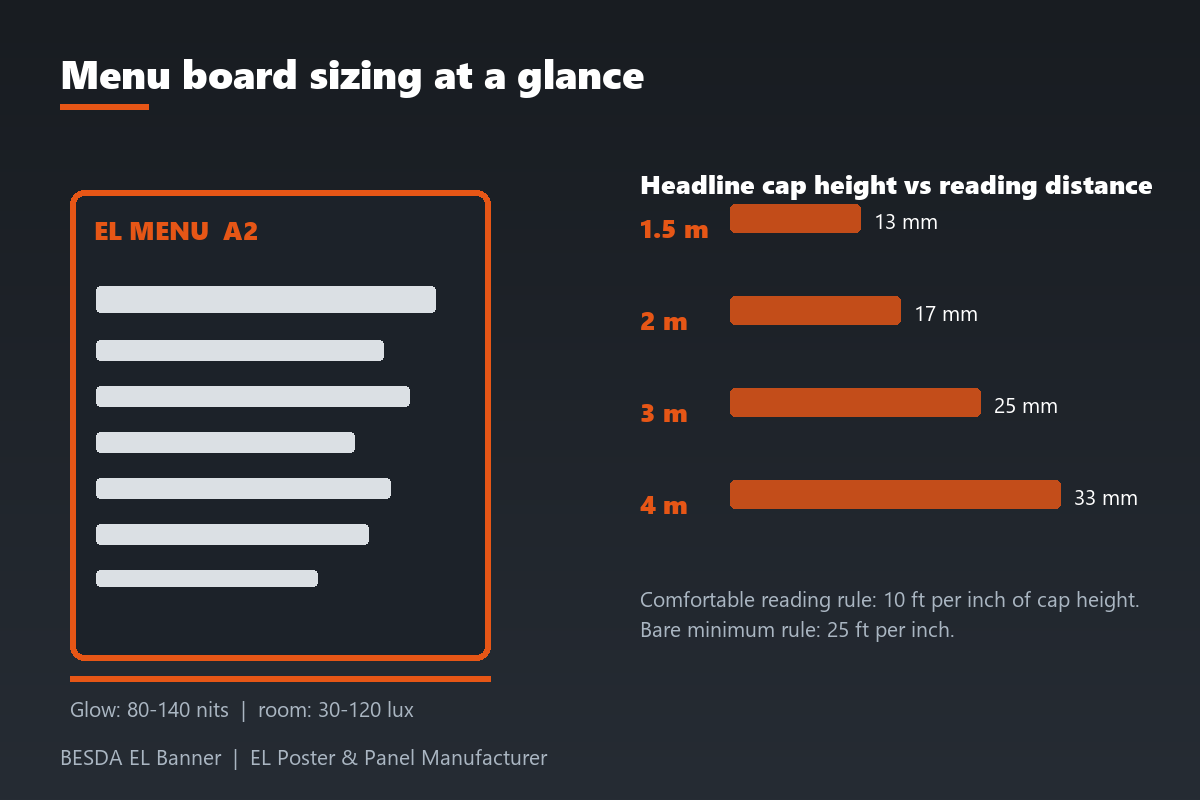
2. Set the headline size from the distance. The long-standing sign rule of thumb is one inch of letter height per 25 feet for bare legibility. For comfortable reading, use one inch per 10 feet:
| Reading distance | Comfortable cap height (10 ft/in rule) | Bare minimum (25 ft/in rule) |
|---|---|---|
| 1.5 m | about 13 mm | about 5 mm |
| 2 m | about 17 mm | about 7 mm |
| 3 m | about 25 mm | about 10 mm |
| 4 m | about 33 mm | about 14 mm |
3. Pick the glow colour and the zones. Aqua-white for the list, a colour accent for headers, and 2-4 zones only if something should pulse. More zones on a small board read as noise.
4. Choose the power route. Fixed board: adapter or 12 V. Movable card: battery box. State the cable exit position, bottom or side, when you order.
5. Decide the mounting. Double-sided tape holds a light A3-A2 panel flat on timber or tile. Standoff bolts suit glass. A slim frame adds a border and protects the edge in busy service.
6. Approve a lit sample, not a screen mockup. Send the menu artwork, receive a mockup within days, and the physical sample follows within 7 days of mockup approval. Read it at your real distance under your real lights before the run.
Type set too fine. A drinks list wants cap heights from the table above. Hairline serifs that work on A4 paper fall apart on a glowing field at 3 m; heavier strokes and clean sans faces survive best.
Designing for daylight. The board ships to a dark room, so proof it in one. A layout that looked bright in the office can vanish at noon by the window and stun at 22:00 by the counter.
Copy inside the dead edge. The silver bus bars run inside a 5-8 mm border that never lights. Prices or logos parked in that strip go dark and half-hidden behind the frame lip.
Thin white type on a lit field. The glow bleeds into thin strokes and the letters close up. Put light type on a dark printed field, or dark type on the glow, and keep the strokes fat.
Ignoring the cable path. The driver needs power, and a dangling cable across a service area is a real hazard. Decide the exit side and the hiding route before production, not during installation.
| Feature | Advantage | Benefit |
|---|---|---|
| 0.3-0.5 mm panel | Mounts flat on timber, tile or glass with tape | No fixture depth lost behind a crowded counter |
| 80-140 nits even sheet | Readable in 30-120 lux without glare | Guests read the list; nobody squints at the table |
| 2-4 animation zones | The special of the night pulses on cue | The offer gets noticed without a video screen |
| USB, battery, 12 V or AC input | Fits fixed boards and movable cards alike | One product family covers the whole venue |
| Cold-light surface | Safe against vinyl, paint and timber | Installs where lamps and screens cannot sit |
| Reprint from 5 pcs | Seasonal menu change stays a small order | The board refreshes with the drinks list |
1. Direct factory source better control quality. Printing, lamination, wiring and the lit-check all happen in our Foshan facility. The panel that lights your menu is checked by the people who built it.
2. 15+ years professional experience. We have made electroluminescent displays for hospitality and beverage programmes since the early 2000s, and dark-room legibility is a solved problem on our floor.
3. Smooth communication & fast response. One named contact answers from artwork to shipment, and we reply within 1 hour, 24×7, in writing.
4. Small qty acceptable. Custom menu posters start from 5 pcs, so a single venue, or one test bar in a group, can order without a warehouse commitment.
5. Cooperated with more than 100+ global brands. Beverage and hospitality campaigns across Europe, the Middle East and the Americas shaped the sizing rules on this page.
6. Stable lead time & fast delivery. Sample within 7 days of mockup approval, standard runs 7-10 days, bulk 15-20 days, confirmed in writing on every order.
A new panel measures 80-140 nits, and our fresh panels start at about 140 nits. A bar runs at 30-120 lux after dark, which is far below the level that washes out a printed face. In that range the glow reads clearly without glaring at guests seated two metres away.
Start from the reading distance, not from the wall. At 2 m a comfortable headline needs about 17 mm cap height, and at 3 m about 25 mm. Most back-bar boards land at A2 to A1, while table cards sit at A4 to A3. We confirm the final size against your counter layout.
Yes, by reprinting the poster. The graphic film and the light layer are sealed into one panel, so a menu change means a fresh print rather than a swap. Repeat orders start from 5 pcs, and the previous file stays on record for the next season.
The inverter makes a faint hum at close range, and a silent driver is available on request. The panel itself is a cold-light surface and stays near room temperature, so it is safe against timber panelling, wallpaper and vinyl wraps.
Four inputs are common: a USB power bank, a battery box, a 12 V feed from the bar equipment, or an AC adapter. Behind a bar the 12 V or adapter route is most typical. The cable can drop from the counter or run inside the frame channel.
Panel life is quoted to half brightness. At roughly 6 hours a night, 8,000 to 25,000 hours equals about 4 to 11 years of service, with the fade gradual rather than sudden. The exact curve depends on drive voltage and frequency, which we state in writing per project.
A bar menu board does not need the brightest sign in the industry. It needs the right brightness for a 30-120 lux room, an even sheet of light behind the type, and a headline sized to the distance. Most bars read the board from 2-4 m. An EL poster delivers all three in a 0.3-0.5 mm sheet that mounts with tape and sips power. Send us your menu layout and counter dimensions through our contact page. We will return a sizing recommendation with a lit sample plan within the hour.
Send the size, quantity and destination country. We reply within 1 hour with feasibility, MOQ and lead time in writing.
Reply within 1 hour, 24×7 online service · [email protected]
Tell us the product, size, quantity and destination country. Attach artwork if you have it.
