WhatsApp: +86 139 2872 8741
Email: [email protected]
Tel:
0086-757-8938 9313
0086-20-8938 9313
Address:
Caochang Industrial Area, Liguang Rd, Lishui, Nanhai, Foshan, Guangdong, China
Reply within 1 hour, 24x7 online service

WhatsApp: +86 139 2872 8741
Email: [email protected]
Tel:
0086-757-8938 9313
0086-20-8938 9313
Address:
Caochang Industrial Area, Liguang Rd, Lishui, Nanhai, Foshan, Guangdong, China
Reply within 1 hour, 24x7 online service
The problem in one line: a lifespan figure without its test conditions is a marketing number – the same panel can be quoted at 8,000 hours or 25,000 depending on how hard it is driven.
We print EL posters in Foshan and quote lifespan the honest way: half-brightness under stated drive conditions, with our own measured fade curve on the table. This page explains what the hours measure, how the fade actually looks, what shortens it, and how long a poster lasts in real venue hours. For the brightness side of the same story, the brightness explainer covers the 80-140 nits band in detail.
| Item | What we confirm in writing |
|---|---|
| Definition | Half-brightness (the hour the glow measures 50% of its starting value) |
| Industry band | About 8,000-25,000 hours, typical, depending on drive conditions |
| Our measured start | About 140 nits on a new panel |
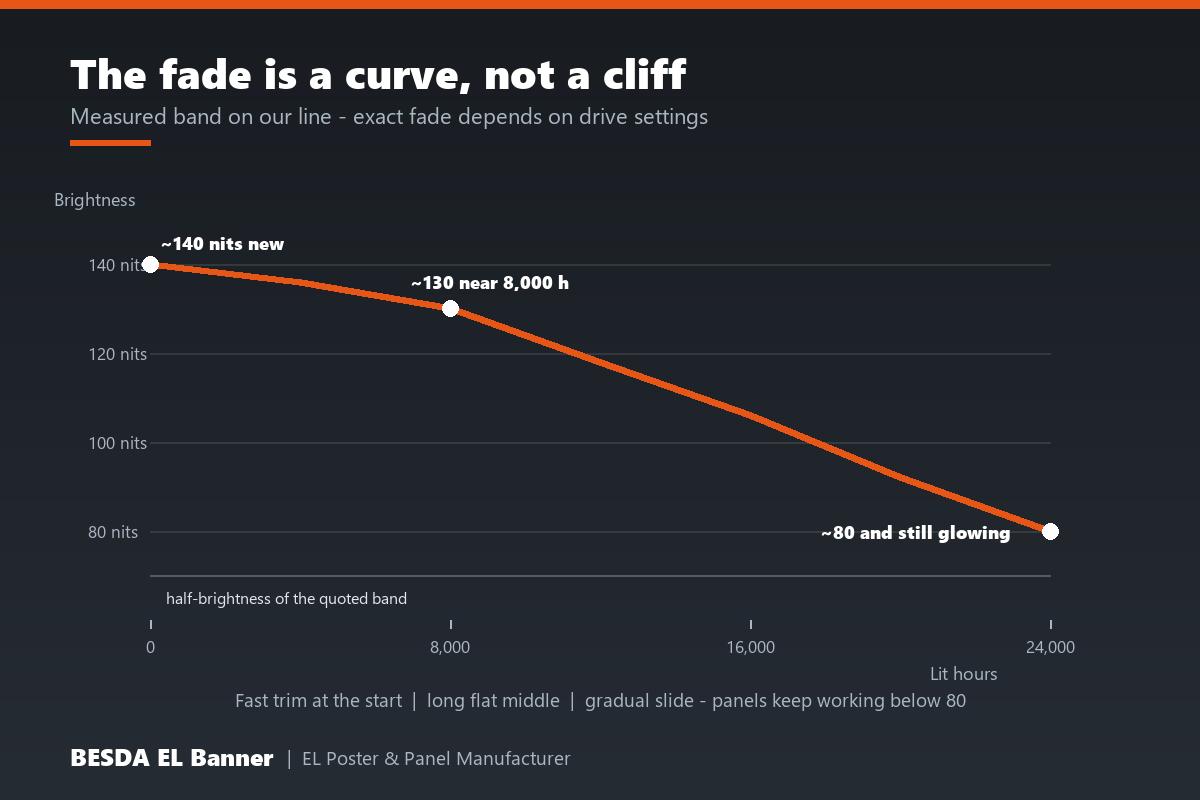
| Our measured curve | Around 130 nits near 8,000 hours, then a gradual slide toward about 80 |
| Below the curve | Panels keep working below 80 nits – they fade, they do not die |
| Wear model | The clock runs only while lit; on-off switching adds no extra wear |
| Fastest killers | High frequency, high voltage, heat, moisture at an unsealed edge |
| Conditions to insist on | Voltage, frequency, duty cycle and temperature, in writing |
| Test method | Lit inspection on every panel plus brightness records, QC photos before packing |
| Certificates | CE, FCC and RoHS available per project on request |
EL lifespan is not a warranty period and not an hour of death. It is the half-brightness point: how many lit hours pass before the panel measures half of its starting brightness. A panel quoted at 8,000-25,000 hours is a panel that will still be glowing, softly, long after that milestone.
The huge spread in that band is not producer optimism – it is drive settings. The same phosphor layer driven gently can take three times as long to reach half-brightness as one driven hard for a brighter first impression. That is why every serious quote names four conditions: voltage, frequency, duty cycle and temperature. A number without them is a guess wearing a suit.
One more honest definition: age in EL shows up as a voltage shift, not a switch-off. An older panel needs slightly more push for the same glow, which is why we set drive presets conservatively rather than at the ceiling.
The real curve has a shape worth knowing. The first few hundred hours trim the peak fastest, the middle stretch is nearly flat, and the far end slides. On our line a new panel starts around 140 nits, holds near 130 approaching 8,000 hours, and then moves gradually down toward 80. Nothing about that is sudden – a poster does not fail on a Tuesday, it simply gets softer over seasons.
Venues rarely notice. A bar wall at closing time, a freezer aisle, a dim reception – all of them hide a 20-nit difference. The meter shows the fade long before your customers do, which is why we photograph and record brightness at QC rather than promising an exact hour of change.
| Hours lit per day | 8,000 hours lasts | 25,000 hours lasts |
|---|---|---|
| 4 h – evening venues, bars | About 5.5 years | About 17 years |
| 8 h – full retail day | About 2.7 years | About 8.5 years |
| 12 h – long campaigns | About 1.8 years | About 5.7 years |
| 24 h – always-on installs | About 0.9 year | About 2.9 years |
Campaign buyers read that table the other way. A seasonal poster reused across 3-5 campaigns at twelve hours a day collects a few hundred lit hours per season – the panel will outlive the campaign concept, the artwork trend and probably the store manager who approved it. Lifespan is rarely the binding constraint in promotional work; it becomes one only in always-on installs.
Rollout planning. A chain that fits 200 stores needs to know when the glow softens, not when it dies. Half-brightness data turns a vague worry into a maintenance date.
Drive presets are a choice. A brighter poster or a longer poster – the factory can set either. Buyers who know the trade-off choose deliberately instead of receiving whatever the default was.
Comparing quotes. Two suppliers quoting 8,000 and 25,000 hours may be selling the same panel driven differently. Asking for conditions turns a price comparison into a specification comparison.
Replacement budgets. Always-on installs need a rotation plan. Knowing the curve means ordering replacements on schedule instead of after complaints.
| Factor | Effect on lifespan | What to do |
|---|---|---|
| Higher frequency | Brightness up, lifespan down | Use a gentle preset for always-on installs |
| Higher voltage | Brightness up, lifespan down | Drive at the preset, not the ceiling |
| Heat | Fade accelerates | Keep drivers ventilated, avoid sealed hot boxes |
| Moisture | Fastest killer of all | Order laminated builds, seal edges, dry storage |
| On-off cycling | No extra wear | Switch freely – the clock runs only while lit |
| Storage | Essentially none | Flat, dry, dark, in the original carton |
| Printed colour | Dimmer start, same curve shape | Colours start lower than aqua-white, fade on the same path |
The moisture line deserves its own warning. Water attacking an unsealed edge degrades the phosphor layer faster than any drive setting, which is why lamination and edge sealing are specification decisions, not extras. Our power supply comparison covers the driver half of the same bargain.
| Situation | Verdict | Why |
|---|---|---|
| Always-on signage in a fixed venue | WORTH IT | Gentle drive plus lamination buys years |
| Multi-store rollout with a maintenance plan | WORTH IT | Half-brightness data sets the replacement date |
| Seasonal campaign reused 3-5 times | WORTH IT | A few hundred hours per season; the panel outlives the concept |
| One-week event, then storage | WORTH IT | Storage costs nothing; reuse next season at full start |
| Chasing maximum brightness for a photo | SKIP IT | Hard driving spends lifetime for a first impression |
| Outdoor build facing rain without sealed edges | SKIP IT | Moisture will end it long before the hours do |
| Video-level motion is the real requirement | SKIP IT | EL fades gracefully but shows no video – use an LCD screen |
That last row is the honest boundary. EL is a slow-fading glow, not a screen. If the brief needs video, say so and we will point you at the right product category – even if it is not ours.
1. Ask for conditions, not hours. Request voltage, frequency, duty cycle and temperature with any lifespan figure. We issue them in the written spec sheet per order.
2. Choose the drive preset on purpose. Tell us the lit-hours per day and we set the preset: gentle for always-on, brighter for short sharp campaigns.
3. Order lamination for damp venues. Freezers, windows and anywhere with cleaning spray need a sealed face. Dry walls can go lighter.
4. Ventilate the driver. The inverter is the part that ages from heat. Leave it airflow, never taped inside a sealed box.
5. Record the start brightness. Keep the QC photo and any meter reading from delivery. A future comparison is the cheapest diagnostic you will ever run.
6. Store flat and dry between seasons. Unpowered panels do not age. Cartons on a shelf are free years.
Comparing hours without conditions. An 8,000-hour quote at a hot drive can outperform a 25,000-hour quote at a gentle one, or the reverse. Conditions first, number second.
Reading half-brightness as failure. Buyers who expect a dead panel at the quoted hour file complaints about a working one. The quote marks a softening, not an end.
Blaming age for a fault. An even fade is age; a dark line, patch or flicker is damage. Our dim-after-a-year checklist separates the two in five checks.
Sealing the driver in a box. The panel runs cold; the inverter does not. Cooked drivers fail long before tired phosphor does.
Leaving posters lit in damp windows. A window build without lamination can lose half its life to condensation before the hour meter says so.
| Feature | Advantage | Benefit |
|---|---|---|
| Lifespan quoted with conditions | Voltage, frequency, duty, temperature in writing | Quotes you can compare line by line |
| Measured 140-to-80 curve | Fade described from our own line, not a brochure | No surprises when posters soften |
| Gentle drive presets | Longer half-brightness where it matters | Always-on installs keep their glow for years |
| Laminated, sealed builds | Moisture – the fastest killer – locked out | Window and freezer builds last their season |
| QC photos with brightness records | A dated baseline for every panel | Future comparisons take minutes, not guesses |
1. Direct factory source better control quality. Printing, lamination and wiring happen in our Foshan facility, so the drive settings and seals we quote are the ones QC checks before packing.
2. 15+ years professional experience. Since the early 2000s we have produced electroluminescent displays for beverage, FMCG and event clients – long enough to watch our own curves come true.
3. Smooth communication & fast response. One named contact handles your order, and we reply within 1 hour, 24×7, in writing.
4. Small qty acceptable. Most custom EL products start from 5 pcs – test the glow on one wall before any production commitment.
5. Cooperated with more than 100+ global brands. Clients across Europe, the Middle East and the Americas taught us to quote conditions, not slogans.
6. Stable lead time & fast delivery. Sample within 7 days of mockup approval, standard runs 7-10 days, larger bulk 15-20 days – dates confirmed in writing before you pay.
It is the time to half-brightness under stated drive conditions – voltage, frequency, duty cycle and temperature. It is not the hour the panel dies. An EL poster past its half-brightness point still glows, just more softly, which is why the test conditions matter more than the number itself.
On our line a new panel measures about 140 nits, holds around 130 near the 8,000-hour mark, then slides gradually toward about 80 – a curve, not a cliff. Panels keep working below 80. Most venue lighting hides the difference long before the meter shows it.
Hard driving comes first: higher frequency and higher voltage buy brightness and spend lifetime. Heat accelerates the fade, and moisture attacking an unsealed edge is the fastest killer of all. On-off switching itself causes no extra wear – the clock runs only while the panel is lit.
You can, and some venues do. Budget the hours honestly: an always-on poster burns through its brightest years in about three. For permanent installs we quote a gentle drive preset and expect the glow to soften rather than fail.
Age fades the whole face evenly. A fault is local: a dark line from a crease, a patch where moisture got in, a connector that flickers. Our checklist for a poster that dims after a year walks through that diagnosis in order before anyone blames the panel.
No. An unpowered EL panel does not age in any way that matters. Years on a flat shelf in a dry carton cost nothing; the same years lit in a damp window would have. Store flat, dry and dark and the panel waits for you.
Lifespan is a curve, not a countdown. Quote it with conditions, drive it gently where the hours are long, keep moisture out of the edges, and store the panels you are not using. Do those four things and an EL poster outlives most of the campaigns it serves. Tell us the lit-hours per day and the venue through our contact page – within the hour you will have a drive preset, the expected curve and lead times in writing.
Send the size, quantity and destination country. We reply within 1 hour with feasibility, MOQ and lead time in writing.
Reply within 1 hour, 24×7 online service · [email protected]
Tell us the product, size, quantity and destination country. Attach artwork if you have it.
