WhatsApp: +86 139 2872 8741
Email: [email protected]
Tel:
0086-757-8938 9313
0086-20-8938 9313
Address:
Caochang Industrial Area, Liguang Rd, Lishui, Nanhai, Foshan, Guangdong, China
Reply within 1 hour, 24x7 online service

WhatsApp: +86 139 2872 8741
Email: [email protected]
Tel:
0086-757-8938 9313
0086-20-8938 9313
Address:
Caochang Industrial Area, Liguang Rd, Lishui, Nanhai, Foshan, Guangdong, China
Reply within 1 hour, 24x7 online service
The problem in one line: brightness quotes without test conditions are marketing – the same EL poster can read 140 nits or 90 depending on how it is driven and where it stands.
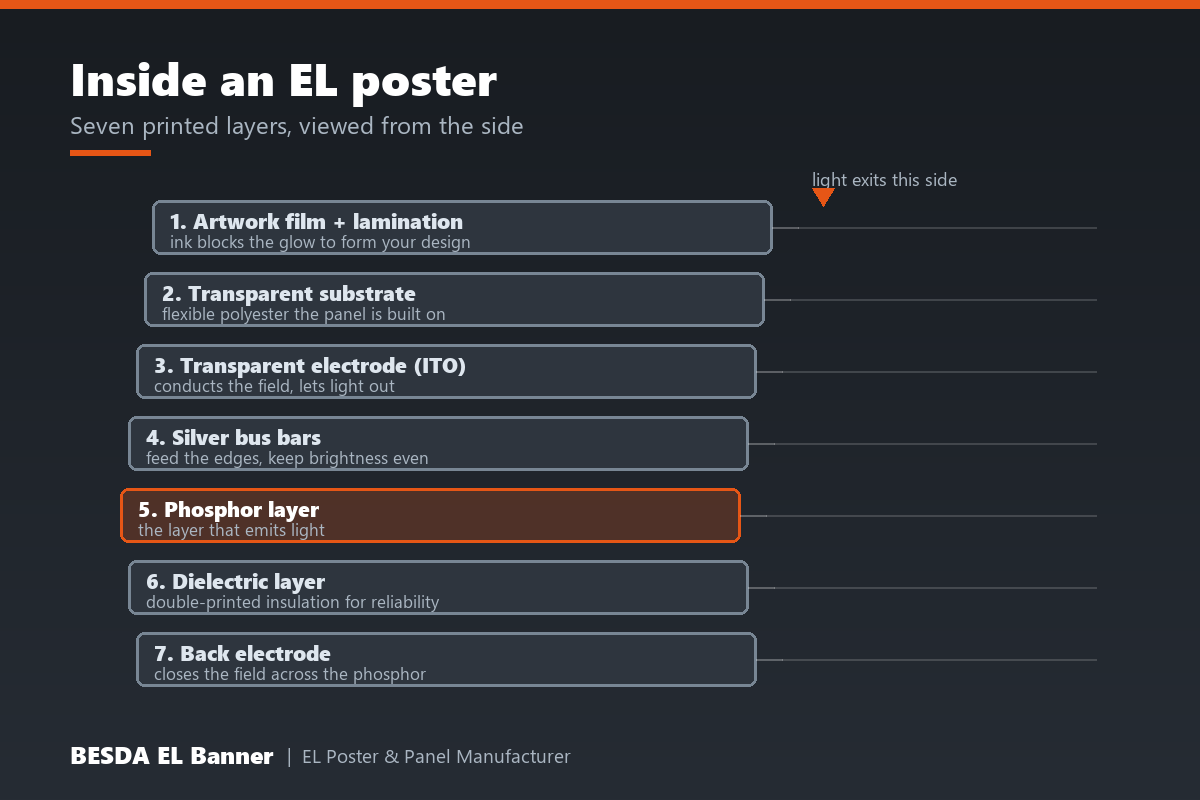
We print EL posters in Foshan and measure every production batch. This page explains what cd/m2 means on a quote, how drive voltage and frequency move brightness, why the glow fades, and how to specify brightness so the sample you approve matches the bulk you receive. For the layer structure behind it all, read how an EL poster actually works.
| Item | The short answer |
|---|---|
| Unit | cd/m2, also called nits; 1 nit = 1 cd/m2 |
| Our band | 80-140 nits; new panels measure around 140 nits |
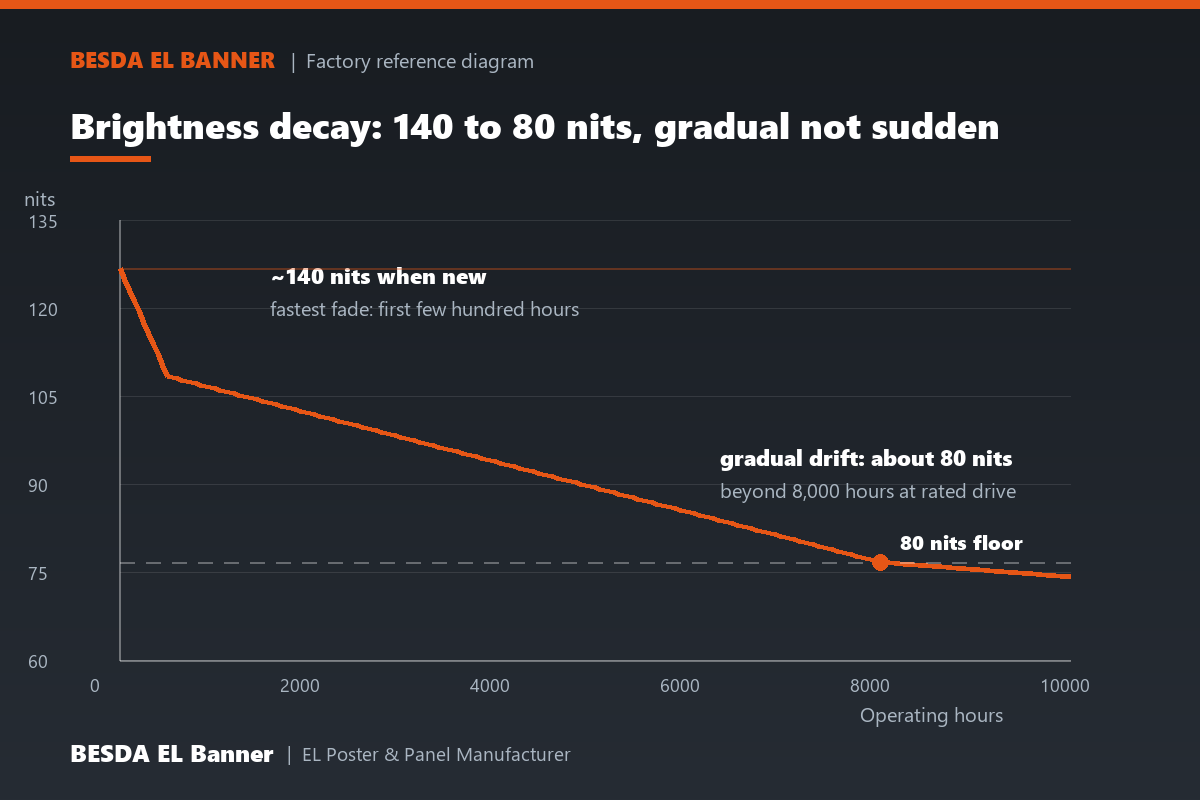
| Decay | Fastest in the first few hundred hours, then gradual – around 80 nits beyond 8,000 hours at rated drive |
| Drive voltage | The inverter supplies roughly 100-200 V AC from a 3V/5V/12V DC or mains input |
| Frequency | 400-2000 Hz typical; more frequency means more light and faster ageing |
| Waveform | Sine-wave drive is kinder to the phosphor than square waves |
| Color effect | Native aqua-white is brightest; filter inks for other colors absorb light |
| Noise | 600-2000 Hz drives can hum faintly; 400 Hz builds run quiet |
| Power draw | About 0.5-2 W per 100 cm²; a full poster and inverter typically draw about what a phone charger does |
| Honest limit | Built for dim and indoor light; direct daylight overpowers the glow |
Brightness on a spec sheet means luminance: how much light leaves one square metre of the glowing face, measured in candela per square metre. One cd/m2 equals one nit, so the two words describe the same number. A poster at 140 nits emits 140 candelas from every square metre of its lit face.
Lux is a different measurement. Lux counts light arriving at a surface, such as the desk under a lamp, while nits count light leaving a display. Buyers who compare a poster’s 140 nits against a room’s 300 lux are comparing different quantities – which is exactly why sample testing happens at the real site, under the real light.
For scale: 140 nits is far below a phone screen at full power, yet an EL poster still reads across a dim aisle. The reason is contrast. In a dark bar, the glowing face is the brightest thing in view. Under bright shop lights, the same face competes with everything around it.
Every brightness conversation we have lands on one of two questions. The first: “Will it read from the aisle?” The second: “How long before it looks tired?” Both answers come from the same three dials – voltage, frequency and duty cycle – so a buyer who understands the dials can judge any quote.
The stakes are real. Drive a panel hard and it turns heads for a season, then fades. Drive it gently and it reads a little dimmer for years. Neither is wrong; the mistake is not choosing on purpose.
The panel is a capacitive load. The inverter steps a low DC input – battery box, USB or 12V rail – up to roughly 100-200 V AC and switches it across the phosphor layer. Two settings decide how bright that layer shines:
Voltage. More voltage pushes more electrons through the phosphor, and the glow rises. Push too far and ageing accelerates. The honest rule: voltage buys brightness and spends lifespan at the same time.
Frequency. The AC field flips 400 to 2000 times per second across typical builds. Each flip is a pulse of light, so higher frequency means more pulses and a brighter face. It also means the phosphor works harder, and the color shifts slightly bluer; low-frequency drives lean greener.
Waveform and noise. A sine wave treats the phosphor gently; harsh square-wave drive shortens life. Audible hum enters the picture from around 600 Hz upward – faint, but noticeable in a quiet shop. For libraries, clinics and bedrooms we quote 400 Hz builds; for loud bars it is irrelevant.
| Setting | Ambient light | How 80-140 nits performs |
|---|---|---|
| Bar, club, restaurant | Very dim | Reads across the room; animated zones carry the message |
| Fridge and cooler aisle | Dim, artificial | Strong; the glow cuts through the cabinet’s own shade |
| Night retail window | Low | Strong; the poster is the brightest object on the street |
| Lit shop interior | Moderate | Readable up close; plan bold shapes and thick strokes |
| Bright showroom | High | Weak; add print layers or choose a lit-frame build |
| Direct daylight | Extreme | Washes out; we quote an LED build instead |
Industry practice sorts drive presets into three groups. The numbers below are typical for printed EL at room temperature; every project’s written spec states the exact settings and test conditions.
| Drive preset | Brightness | Lifespan behavior | Typical use |
|---|---|---|---|
| 400 Hz, gentle | Lower end of the band | Longest; the quiet option | Quiet venues, always-on displays |
| 600 Hz, standard | Mid band | Balanced; the common choice | Retail windows, menu boards |
| 1000+ Hz, hot | Top of the band | Shorter; brightness fades sooner | Short campaigns, loud venues |
Duty cycle matters as much as the dials. A poster lit 8 hours a day ages far slower than one burning around the clock, and scheduled off-hours stretch calendar life noticeably. Sealed edges and dry storage protect the phosphor too – moisture is the fastest killer after overdrive. Bare panels and finished posters share these dials; the panel vs poster comparison shows where the two builds fork.
| Feature (spec) | Advantage (what it does) | Benefit (what you get) |
|---|---|---|
| 80-140 nits measured band | Brightness quoted with test conditions | Quotes match the panels that arrive |
| Around 140 nits when new | Strong first-season impact | The display earns attention from day one |
| Gradual decay to about 80 nits | No sudden failure to plan around | Campaigns end on schedule, not early |
| 400-2000 Hz drive options | Brightness tuned to the venue | Quiet builds for quiet rooms, hot builds for bars |
| About 0.5-2 W per 100 cm² | Low draw, cool to touch | Runs on batteries where no socket exists |
| Written spec per project | Band, drive, conditions on paper | Your QC team checks facts, not feelings |
| Worth it when | Skip it when |
|---|---|
| The venue is loud and bright: bars, clubs, events | The room is quiet and dim – a gentle drive looks identical there |
| The campaign runs weeks, not years | The display must serve seasons on one drive setting |
| The panel sits behind dark filter inks | The design is native aqua-white, already the brightest option |
| The client accepts a shorter service life in writing | The buyer expects LED-class durability from EL |
| A sample proved the setting at the real site | Nobody tested the sample under the real light |
And the honest limit, again: no drive setting fixes daylight. If the poster faces the sun, the correct answer is an EL light box or LED build, and we will quote that instead of an EL panel that will disappoint you.
1. Survey the real light. Note the venue’s brightest hours, the nearest lamps and whether daylight reaches the surface. A phone photo with timestamps settles most debates.
2. Set the viewing distance. Two metres needs less punch than eight. Distance plus ambient light decides where on the band the panel should sit.
3. Choose color with the brightness tax in mind. Native aqua-white glows brightest; deep blues and reds cost output. If the brand color is dark, plan bolder shapes or a brighter drive.
4. State the duty cycle. Hours per day, days per week, storage between campaigns. The drive preset and the lifespan promise both follow from this.
5. Demand the written spec. Band, drive voltage, frequency, measurement conditions – then test the physical sample at the real site. Our power supply guide pairs with this step.
Comparing quotes without test conditions. A bare “140 nits” claim means nothing until voltage, frequency and warm-up are stated. Ask for the conditions, in writing.
Chasing maximum nits by default. Hot drive shortens life. In a dim room the gentle preset looks the same and lasts years longer.
Ignoring the color tax. A dark red design on the brightest drive still reads dimmer than white shapes on a gentle one. Plan the artwork with the physics.
Running 24/7 out of habit. Off hours are free lifespan. A timer or a staff routine beats a faded poster every time.
Diagnosing fade by eye alone. Ageing is gradual, and eyes adapt. A meter reading against the written spec – or our dim-poster checklist – finds the real cause, which is sometimes just a tired battery.
1. Direct factory source, better quality control. Panels are printed, laminated and wired in our Foshan facility. No trading layer between you and the line, so a spec change reaches the operator the same day instead of a week later.
2. 15+ years professional & expert experience. We have been producing electroluminescent displays since the early 2000s for beverage, FMCG and event clients. That history is why we can tell you in the first call whether your idea will print cleanly.
3. Smooth communication & fast response. One named contact handles your order from quote to shipping. We reply within 1 hour, 24×7, and we answer in writing so nothing depends on a phone call you cannot forward to your team.
4. Small qty acceptable. Most custom EL products start from 5 pcs. You can test a market, a single store or one event before committing to a production run.
5. Cooperated with more than 100+ global brands. Work from beverage, cosmetics, telecom and retail clients across Europe, the Middle East and the Americas has taught us the artwork and compliance quirks of each market.
6. Stable lead time & fast delivery. Production slots are booked when your deposit lands, and the sampling and bulk dates are confirmed in writing. If a deadline is unrealistic we say so before you pay, not after.
Our panels measure in the 80-140 nits band, around 140 nits when new, under the rated drive for the panel size. That reads clearly in dim and indoor light; direct sunlight washes the glow out.
With a cd/m2 meter at the panel centre, after warm-up, at the rated voltage and frequency. Every quote and spec sheet states the test conditions, because the same panel moves on the dial as drive changes.
EL brightness decays fastest in the first few hundred hours, then eases gradually – roughly 140 nits new, drifting toward about 80 nits beyond 8,000 hours at rated drive. Higher drive, heat and moisture speed the fade.
Yes. The phosphor’s native aqua-white is the brightest. Other colors come from filter inks that absorb light, so a red or blue poster glows dimmer than a white one at the same drive.
Within limits: higher voltage and frequency push brightness up and lifespan down. We match the drive to the panel size and the room, and we confirm the trade-off in writing before sampling.
For evening and night windows, yes. For a window that takes direct sun, no – the glow washes out and we recommend an LED light box instead. Test the sample in the real spot before bulk.
Brightness is a bargain, not a number: voltage and frequency buy glow and spend lifespan, color filters take their cut, and the room decides whether 80 or 140 nits is enough. Get the test conditions in writing, drive the panel for the venue you actually have, and test the sample where it will live. Low MOQ accepted – wholesale runs start from 5+ pcs, so a pilot costs one store, not a chain. Send the venue, the distance and the duty cycle through our contact page, or start from the size bands on our custom EL posters page – the written spec comes back within the hour.
Send the size, quantity and destination country. We reply within 1 hour with feasibility, MOQ and lead time in writing.
Reply within 1 hour, 24×7 online service · [email protected]
Tell us the product, size, quantity and destination country. Attach artwork if you have it.