WhatsApp: +86 139 2872 8741
Email: [email protected]
Tel:
0086-757-8938 9313
0086-20-8938 9313
Address:
Caochang Industrial Area, Liguang Rd, Lishui, Nanhai, Foshan, Guangdong, China
Reply within 1 hour, 24x7 online service

WhatsApp: +86 139 2872 8741
Email: [email protected]
Tel:
0086-757-8938 9313
0086-20-8938 9313
Address:
Caochang Industrial Area, Liguang Rd, Lishui, Nanhai, Foshan, Guangdong, China
Reply within 1 hour, 24x7 online service
The problem in one line: a shaped poster is not a rectangle with the corners trimmed – the outline decides where the bus bar can run, so feasibility is settled in the vector file, not on the cutting table.
We print and die-cut EL posters in Foshan and accept low MOQ from 5+ pcs. This page walks a closed vector path through the whole build: the dead edge, the thinnest stroke that still glows, the bus bar route, the die, and the sample you sign. For the wider first-order process, the first-order questions page covers MOQ, artwork files and approvals in one place.
| Item | What we confirm in writing |
|---|---|
| Shape range | Any closed outline a die can follow – logos, letterforms, bottles, badges, product cut-outs |
| Minimum lit stroke | About 5 mm safe; 3 mm after a printed proof on the real material |
| Dead edge | Roughly 5-8 mm around the outline, carrying the bus bar – it does not light |
| Panel thickness | 0.3-0.5 mm for the printed EL stack; lamination adds a film layer, confirm per project |
| Bend radius | About 5-10 mm on gentle curves; flat mounting is always safer |
| Largest single piece | About 1 m x 2 m of lit area; beyond that shapes are joined, seam on request |
| Artwork | Vector AI or PDF, closed paths, no clipping masks, images at 300 dpi |
| Sampling | Mockup first; a physical sample ships within 7 days of mockup approval |
| Order size | Low MOQ accepted – most first shaped runs start from 5+ pcs |
| Certificates | CE, FCC and RoHS available per project on request |
A custom shape EL poster is a printed electroluminescent stack cut to a closed outline instead of a rectangle. The stack itself does not change: artwork film, transparent PET base, ITO electrode, silver bus bars, phosphor, dielectric and back electrode. What changes is the perimeter. A rectangle carries its bus bar in a straight band on one edge. A shape has to route that same conductor around curves, corners and narrow necks.
That is why two questions decide every shaped job. Where does the current enter, and how thin can the light get before it stops reading as a line? Both are answered on paper, before a die is cut. A supplier who quotes a shape without asking for a vector file is quoting a guess.
It also helps to separate the shaped poster from the shaped sticker. A sticker is a thin cut-to-shape build for fridges, bottles and windows, usually battery driven. A poster is the same light source with a printed face, lamination and a mounting method. Our EL stickers page shows the thinner family; this page is about the mounted build.
The shape does the branding. A bottle silhouette needs no caption to say what is being launched. A letterform carries a wordmark without a printed frame around it. In a dark venue the outline is the message, and the copy becomes secondary.
Light stops where the object stops. A rectangle spills glow past the product it advertises. A shaped build puts light only inside the silhouette, which reads as a designed object rather than a lit panel hanging on a wall.
It fits openings that are not rectangular. Kiosk windows, cooler doors with rounded corners, die-cut shelf units and vehicle side panels all reject a rectangle. A shaped build sits inside the opening without a visible frame or a black mask covering the gap.
It survives handling better than a mask. Masking a rectangle down to a shape leaves printed edges that lift and curl. The die-cut edge is a sealed edge, and sealed edges are what keep moisture out of the stack.
1. Path cleanup. We take your AI or PDF, close every path, remove clipping masks and convert text to outlines. Open paths and mask layers are the two most common reasons a shape cannot be quoted the same day.
2. Offset for the dead edge. The cut line is offset inward so a band of roughly 5-8 mm stays unlit around the outline. That band is not waste – it carries the bus bar and isolates the electrodes from the cut.
3. Bus bar route. The silver conductor is drawn around the lit area, usually 2-3 mm wide, and must stay continuous. At least one edge of the bus bar has to survive the die, which is why a shape with a narrow neck or a long thin tail sometimes needs a second entry point.
4. Die and printed proof. A steel rule die is cut to the approved path. Before that, a printed proof on the real material shows how the thin strokes behave at actual size, on the actual ink.
5. Sample and sign-off. A physical sample ships within 7 days of mockup approval, die-cut, wired and lit. You check it on the real surface under the real light before the run.
If the design moves into animation, the same path is split into lit zones and a zone map is approved before printing. Our explanation of how an EL poster works covers the layer stack and the driver in more detail.
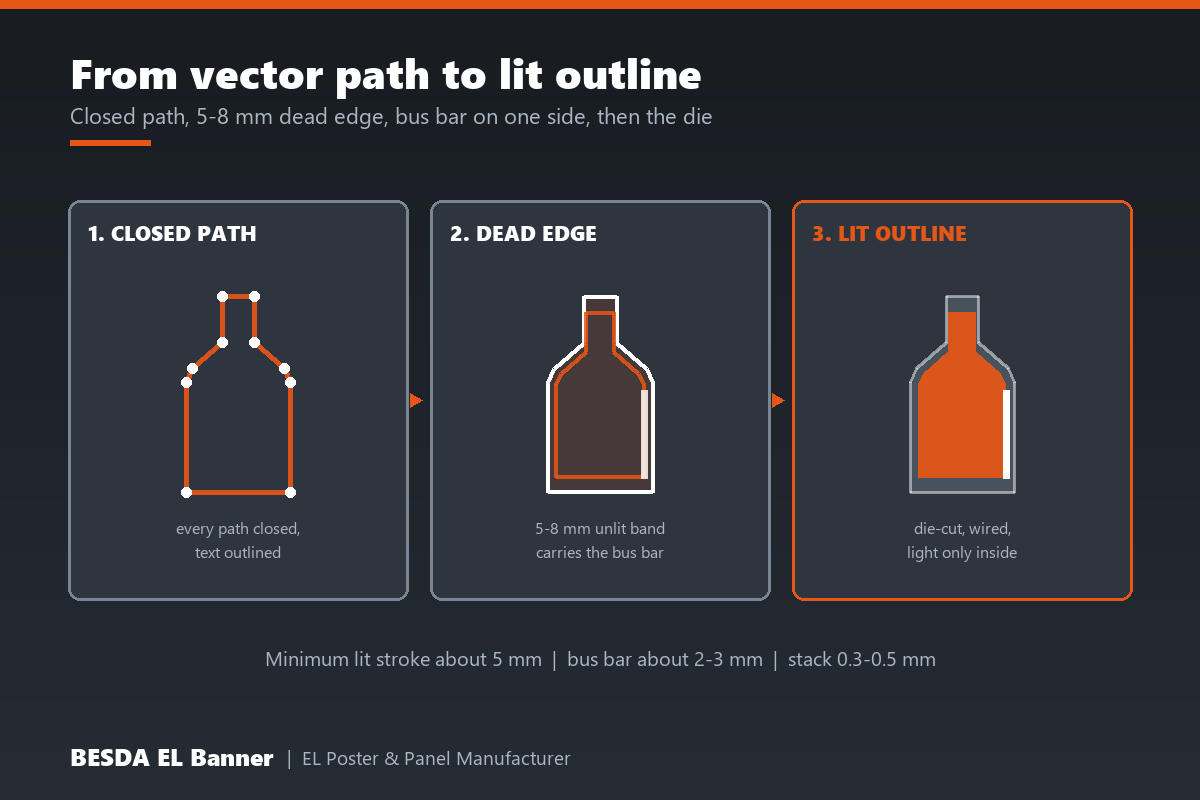
| Parameter | Working value | Why it matters |
|---|---|---|
| Minimum lit stroke | About 5 mm; 3 mm after proof | Thinner strokes read as dull edges, not lines |
| Dead edge around the cut | About 5-8 mm | Carries the bus bar and seals the cut |
| Bus bar width | About 2-3 mm | Must stay continuous after die-cutting |
| Panel thickness | 0.3-0.5 mm | Thin enough to cut, thick enough to handle |
| Bend radius | About 5-10 mm | Tighter curves crack the transparent electrode |
| Largest lit area | About 1 m x 2 m | Bigger shapes are joined with a seam |
| Seam gap | About 0.5 mm | A thin unlit line where two pieces meet |
| Cut tolerance | Confirm per project | Complex outlines need a drawing check first |
Treat these as the working band, not a promise for every outline. A shape with long hair-thin whiskers and a shape with a fat badge outline are different jobs even at the same size. Send the path and we confirm the numbers for that path in writing.
Beverage launches. A bottle outline on a back bar or a cooler door, lit from inside the silhouette, reads at ten metres in a dark room. It also travels: the same shape is reused across a season.
Wordmarks and letterforms. Single letters, monograms and short words die-cut as a single cut, so a logo glows without a printed plate behind it.
Retail end caps and shelf units. Product cut-outs that follow a pack silhouette sit on a shelf edge without a frame and without covering the product behind them.
Kiosks and counters. Rounded-corner windows and curved counter faces take a shaped build where a rectangle would need masking.
Events and standees. Flat, light and rollable, a shaped piece travels in a tube and lights on arrival. Our applications page covers which venues suit EL and which do not.
| Custom shape | Rectangular build | |
|---|---|---|
| Tooling | A die cut to your path | Standard cut, no new die |
| Dead edge | Follows the outline, 5-8 mm | Straight band on four sides |
| Artwork work | Path cleanup and offset | Print ready as supplied |
| Setup effort | Higher – die plus proof | Lower – straight to print |
| Visual effect | Silhouette carries the brand | Frame carries the brand |
| Reorders | Die stays on file | No tooling to keep |
| Best for | Launches, logos, product cut-outs | Menus, campaigns, repeat signage |
The honest split: rectangles win on setup effort and speed, shapes win on recognition. A shaped build earns its extra round when the silhouette is the point and the piece will be reused. Our panel versus poster comparison covers the neighbouring question of what you are actually buying.
| Situation | Verdict | Why |
|---|---|---|
| The silhouette is the brand – bottle, badge, letterform | DO IT | Recognition without copy; reuses across a season |
| The opening is not rectangular | DO IT | Avoids masking and a visible frame |
| Repeating across stores or campaigns | DO IT | Die and artwork stay on file for reorders |
| Lit strokes thinner than about 3 mm | SKIP IT | The edge of the phosphor dominates; lines look soft |
| Lace-like internal detail | SKIP IT | Die and print tolerances cannot hold fine mesh |
| Sharp internal corners and deep narrow slots | SKIP IT | Bus bar cannot stay continuous through the neck |
| Strong daylight or full outdoor sun | SKIP IT | EL loses contrast in bright light – use LED instead |
| One event, no reuse, budget is tight | SKIP IT | Die and proof effort is spent once; a rectangle is cheaper |
That last group is not a sales pitch against ourselves. A shaped die-cut piece with no reuse plan spends its setup on a single afternoon. If the shape will not repeat, a rectangular poster with the same artwork usually serves better.
1. Measure the opening, not the object. Height, width and the tightest internal radius. A photo with a tape measure in frame saves an email round and prevents a remake.
2. Send a closed vector path. AI or PDF, text converted, paths closed. If the outline only exists as a JPG, say so early – rebuilding it is a design step, not a print step.
3. Settle the dead edge in the design. Draw the 5-8 mm border inside the outline yourself so the artwork sits where you expect it after the cut.
4. Choose the connector exit before the die. The lead exits the bottom, the side or hidden at the back. That choice moves the bus bar and sometimes changes the outline.
5. Decide the switch and driver. Battery box, USB, 12V or mains changes the wire and the mounting depth. Our power supply comparison sets out the four options.
6. Approve a physical sample. Lit, on the real surface, at the real hour. Then the run goes ahead on a signed spec sheet that lists thickness, drive settings, connector and packing.
Hairline strokes in the artwork. A 1 mm stroke looks crisp on screen and disappears on the panel. Thicken lit details to the working minimum before the path is approved.
Cutting through the bus bar. A shape with a long thin tail looks elegant and can sever the only conductor. Either widen the tail or accept a second entry point.
Forgetting the dead edge in the layout. Artwork that runs to the cut line loses a band to the border, and the logo shifts off centre after the die.
Supplying a PNG outline. Raster edges rebuild with wobble, and every wobble becomes a die problem. Vector or a paid redraw.
Bending the sample to fit a carton. A shaped piece creased at the connector can fail on site. Pack flat, or roll at a large diameter only.
| Feature | Advantage | Benefit |
|---|---|---|
| Die cut to a closed vector path | Silhouette becomes the brand mark | Recognition without a printed frame |
| 5-8 mm dead edge planned in | Bus bar and seal survive the cut | Edges stay sealed and lit area stays even |
| 5 mm minimum lit stroke | Lines read as lines, not smudges | Thin letterforms survive at real size |
| Die and artwork kept on file | Reorders skip tooling | Season two starts in days, not weeks |
| Low MOQ from 5+ pcs | Test one shape in one venue | No warehouse of untested stock |
1. Direct factory source better control quality. Printing, lamination, die-cutting and wiring happen in our Foshan facility, so the shape that leaves the die is the shape QC lights and checks.
2. 15+ years professional experience. Since the early 2000s we have produced electroluminescent displays for beverage, FMCG and event clients, including shaped runs that had to repeat across seasons.
3. Smooth communication & fast response. One named contact handles your shape from path cleanup to packing, and we reply within 1 hour, 24×7, in writing.
4. Small qty acceptable. Most custom EL products start from 5 pcs – test one shape in one venue before any production commitment.
5. Cooperated with more than 100+ global brands. Clients across Europe, the Middle East and the Americas taught us the artwork and compliance habits that keep shaped runs moving.
6. Stable lead time & fast delivery. Sample within 7 days of mockup approval, standard runs 7-10 days, larger bulk 15-20 days – dates confirmed in writing before you pay.
Any closed outline a steel rule die can follow: letterforms, bottle silhouettes, badge and shield outlines, product cut-outs and logo shapes. The outline is rarely the limit. The glowing stroke inside it is, so thin details decide what survives.
About 5 mm of lit stroke is the safe working figure, and 3 mm is possible after a printed proof on the real material. Below that the edge of the phosphor layer starts to dominate and the line reads as dull, not sharp.
Yes, budget for it. A dead edge of roughly 5-8 mm runs around the outline and carries the bus bar, so nothing lights in that band. Design the shape with that border already inside it and the cut looks intentional rather than clipped.
A vector file, AI or PDF, with closed paths and no clipping masks. JPG or PNG outlines get rebuilt, which adds a round of approval. Send the physical size and the surface photo with a tape measure and the quote is faster.
Yes, typically 2-4 lit zones on A3-sized builds and 5-8 zones on A2 and above. Each zone needs its own bus bar route, so the shape has to leave room for those tracks. The zone map is approved before anything is printed.
Usually yes, within a bend radius of about 5-10 mm and on gentle curves. Sharp creases, repeated flexing and cylinders tighter than that crack the transparent electrode and leave dark lines. Flat or gently curved mounting is the safe design.
A shaped EL poster is a design decision and an electrical one at the same time. Keep lit strokes at about 5 mm, plan a 5-8 mm dead edge, keep the bus bar continuous, and confirm the outline on a path drawing before the die is cut. Do those four things and the shape lights the way it looked on screen. Send your outline, physical size and destination country through our contact page – within the hour you will have feasibility and lead times in writing.
Send the size, quantity and destination country. We reply within 1 hour with feasibility, MOQ and lead time in writing.
Reply within 1 hour, 24×7 online service · [email protected]
Tell us the product, size, quantity and destination country. Attach artwork if you have it.
